
DEEP DIVE
Meat is abundant, yet fat is scarce… The paradox of A-fat supporting domestic Fuji prices
Competition intensifies in domestic Fuji beef market as 33,000 tons of Spanish pork shoulder flow in and Brazilian raw meat joins the fray
A supply-demand imbalance is emerging in the domestic pork raw meat market, characterized by an oversupply of meat and a shortage of fat. While domestic pork hind leg meat is facing price pressure due to the expansion of alternative sourcing options, such as imported shoulder cuts, the price of pork A-grade fat—essential for manufacturing dumplings, ham, and sausages—is actually skyrocketing. Industry sources suggest that linked purchasing, which involves buying even hind leg meat to secure fat, is propping up the price of hind leg meat.
The problem is that there is no guarantee this structure will continue. If the price of domestic A-grade fat rises further and meat processing companies switch to imported fat, the necessity for linked purchasing of hind leg meat could also weaken. It is a paradox that while rising fat prices serve as an immediate pillar for hind leg trading, an excessive increase could actually undermine that very support.

Spain and Brazil Fill the Gaps Left by US Wood Pruners
Changes in the domestic pork loin market stemmed from the raw material purchasing strategies of meat processing companies. Manufacturers of processed foods such as ham, sausages, and dumplings utilize a variety of raw meats, including domestic pork loin and imported shoulder and neck cuts, depending on product characteristics and costs. Industry sources indicate that manufacturers have recently diversified their purchasing sources to include Spanish shoulder cuts and Brazilian raw meat due to the increasing price burden of U.S. neck cuts.
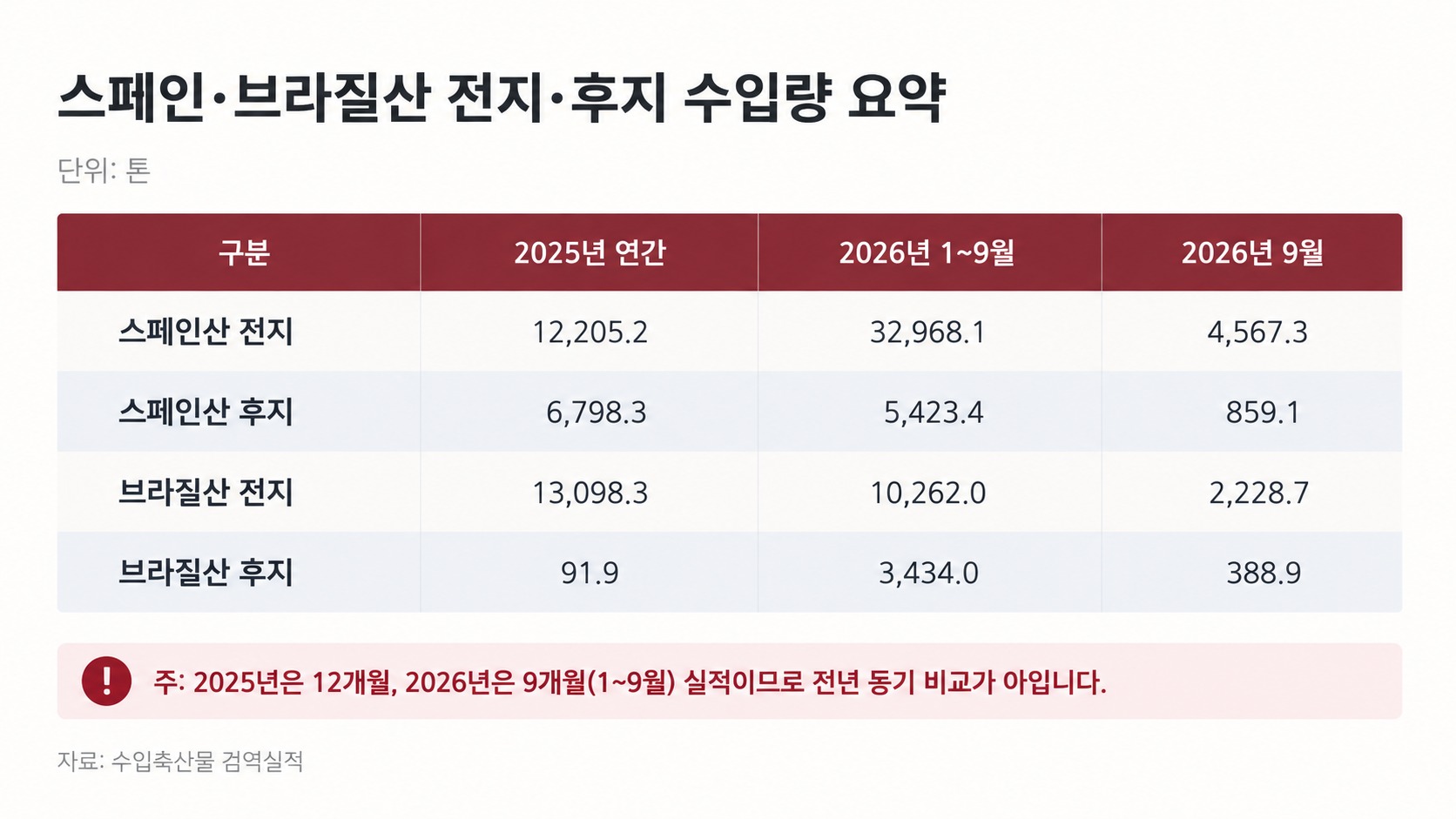
Diversification of supply sources is also prominent in actual import quarantine data.Imports of Spanish batteries from January to September 2026 amounted to 32,968 tons.This is approximately 2.7 times the annual performance of 12,205 tons in 2025. During the same period, 10,262 tons of Brazilian batteries and 3,434 tons of Fuji batteries were imported. In particular, the scale of market inflow for Brazilian Fuji batteries has changed significantly, given that the annual performance in 2025 was approximately 92 tons.
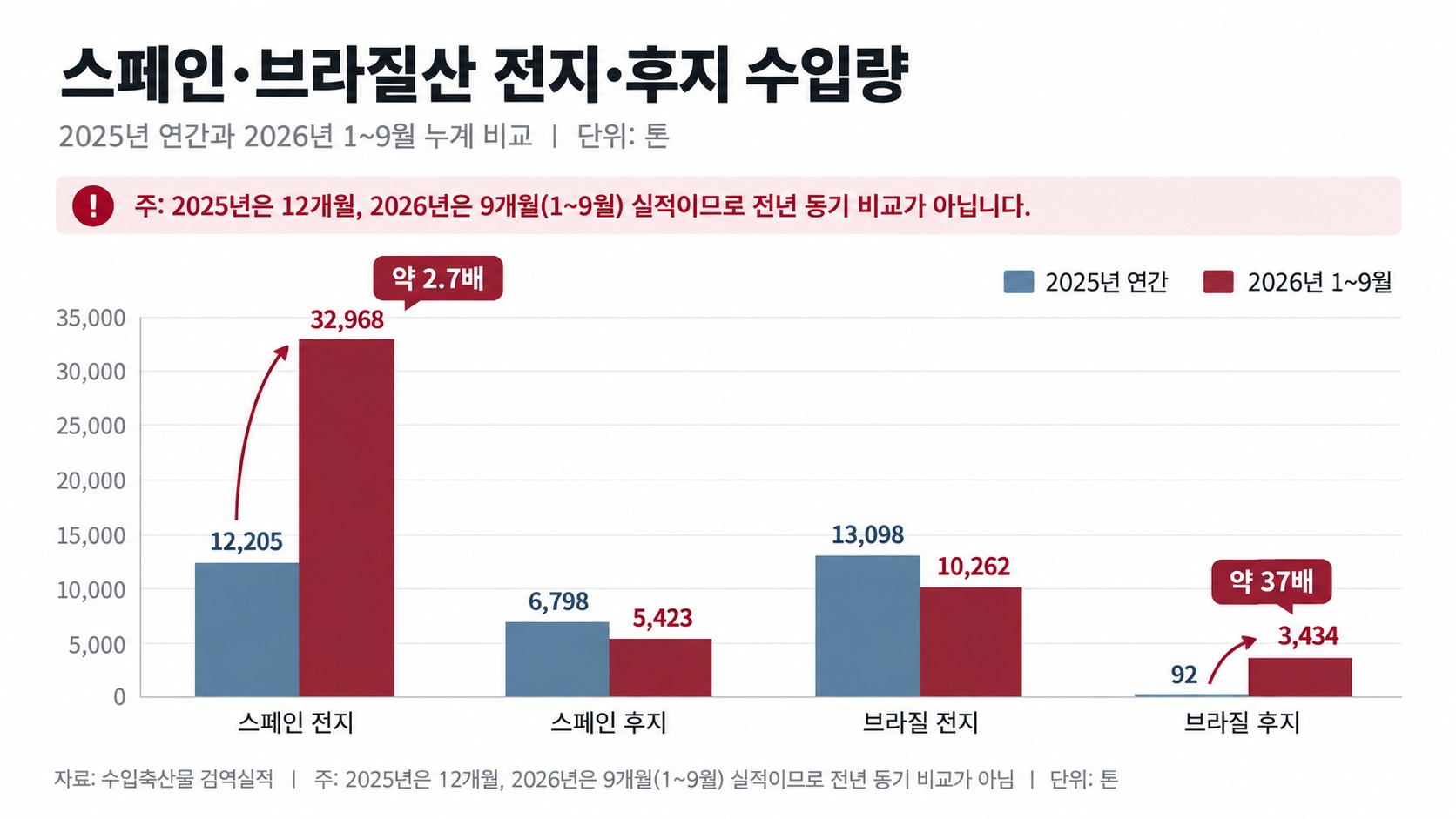
Imports of Spanish batteries in just the first nine months of this year have already significantly exceeded the total for the entire 12 months of last year. This suggests that competitive pressure in the domestic Fuji market cannot be explained solely by the tariff-quotaed volume from Brazil. While imported batteries and domestic Fuji are not identical in terms of product composition and application, it is clear that processors now have more raw material options.
September Battery Import Market: U.S. and Spain of Similar Size
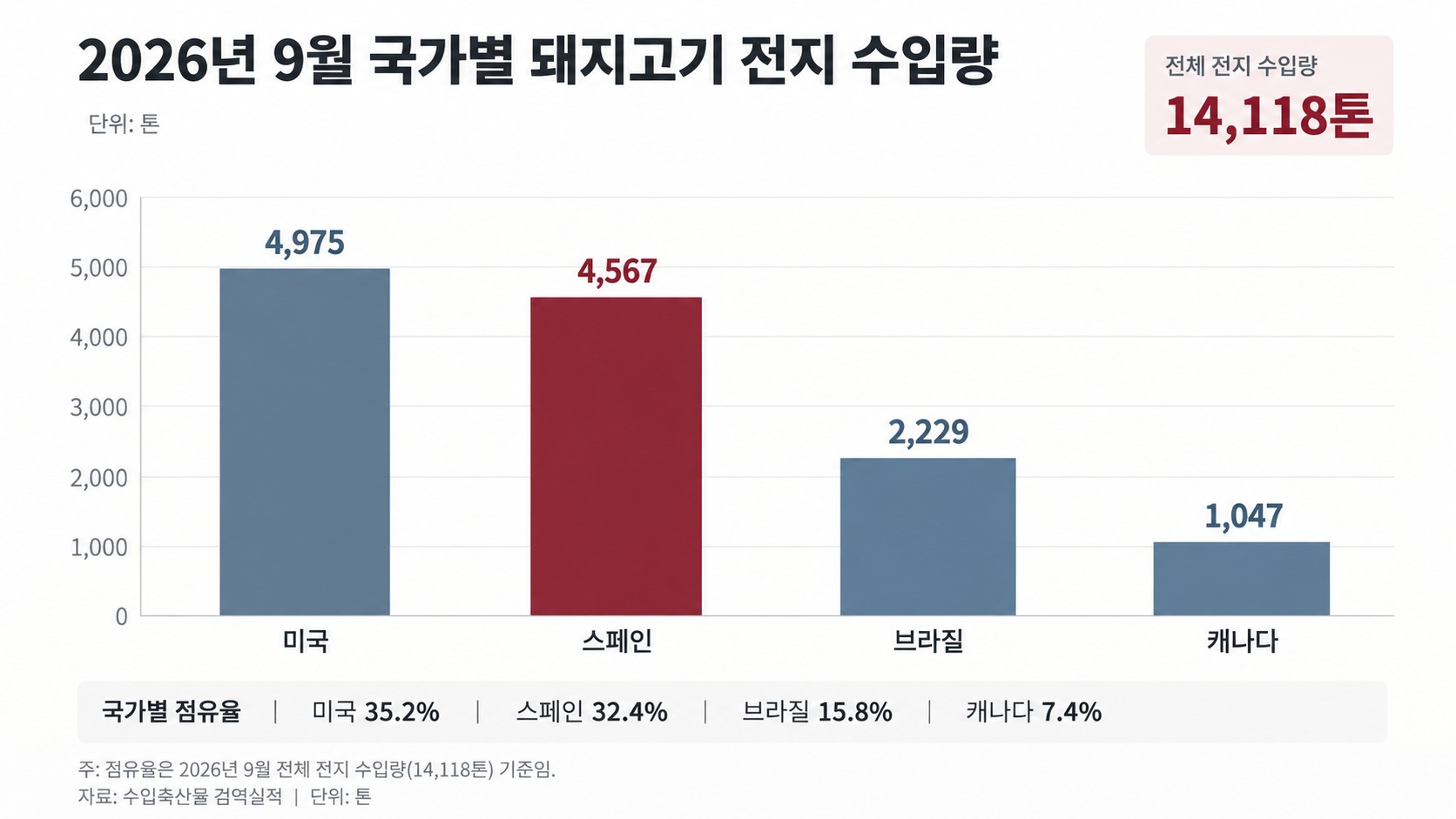
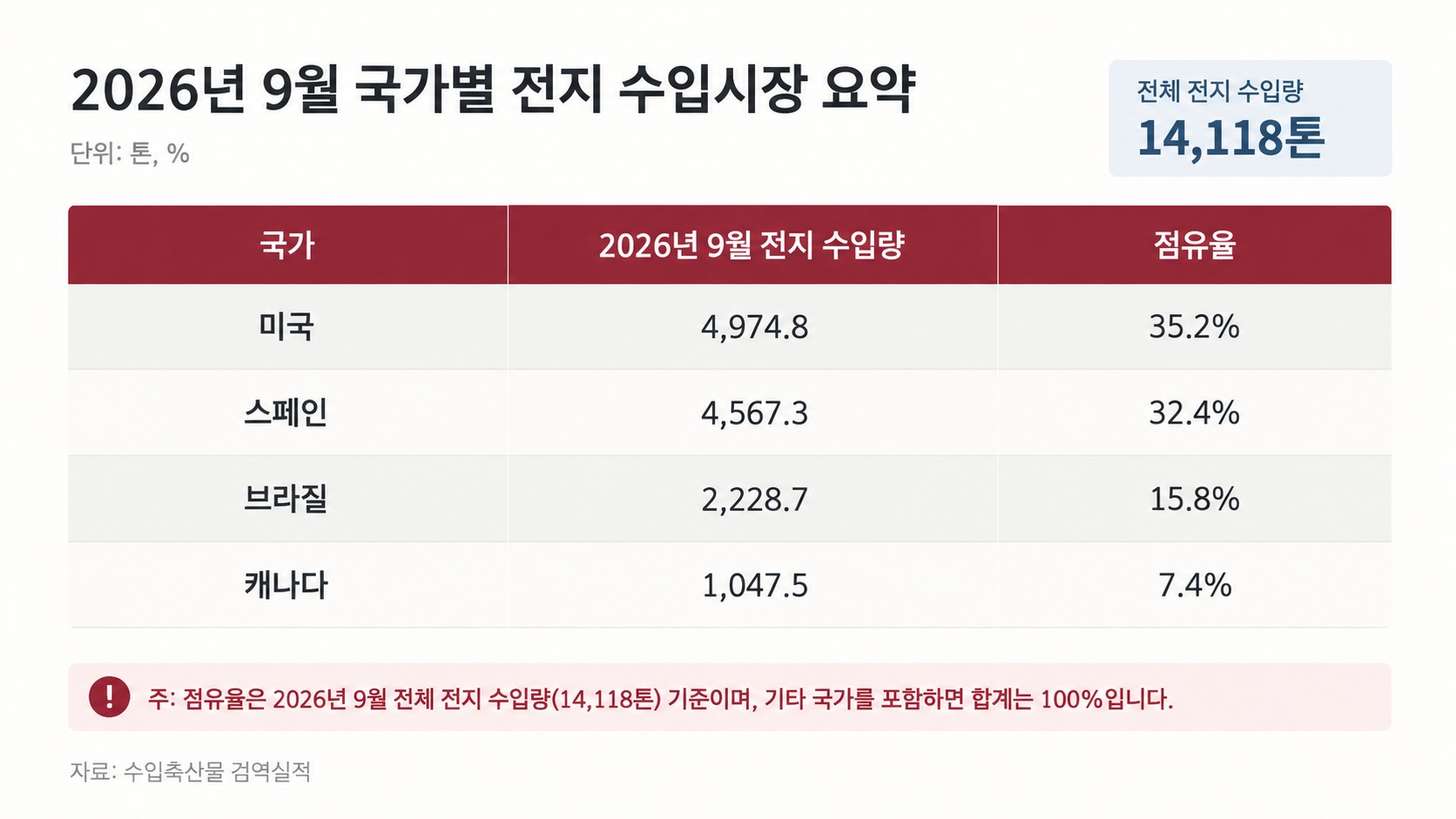
The changes in the structure of the import market are even more evident in the September figures. While imports of batteries from the United States totaled 4,975 tons, those from Spain approached closely at 4,567 tons. 2,229 tons of batteries were imported from Brazil as well. Out of a total battery import volume of approximately 14,118 tons, the market shares were 35.2% for the United States, 32.4% for Spain, and 15.8% for Brazil.
The combined proportion of Spanish and Brazilian products is approximately48.1%C. While it is confirmed that the supply volume from the two countries has increased, separate purchasing records are required to determine which companies have replaced domestic Fuji paper and to what extent.
Procurement options have expanded due to tariff quotas, but… domestic Fuji is under pressure
The government has decided to apply a 0% tariff quota to 12,000 tons of frozen pork raw materials from May 29, 2026, until the end of the year. This measure aims to lower the procurement costs of raw materials for meat processing. This system is distinct from the regulations for general packaged meat sales, such as pork belly, and the total volume of imports from Brazil does not necessarily match the volume subject to the tariff quota.
If the supply of imported raw meat becomes stable, the use of domestic pork hind leg may decrease even if the production or consumption of processed meat products does not decline. This is because demand in the domestic pork hind leg market shrinks even if companies change their raw material composition while maintaining production volumes. Therefore, there are limitations to explaining the recent deterioration of the pork hind leg market solely by the production sluggishness of domestic meat processing companies.
Price difference of around 1,000 won… Incentive to choose imported products
At the time of coverage, the purchase price of domestic Fuji was approximately per kg.4,700~4,800 wonIt was mentioned as such. On the other hand, the import price of some imported raw meat, such as from Spain, reflecting exchange rates and logistics costs, is approximately per kg.3,700~3,900 wonIt was mentioned as being at a level. Although it varies depending on transaction conditions and specifications, a difference of about 800 to 1,100 won per kg is a significant difference in the purchasing strategies of large processing companies.
Changing raw meat ingredients entails procedures to adjust packaging country of origin labeling, blending specifications, and existing supply contracts. The industry explains that once the purchasing structure shifts to be centered on imported raw materials, it is difficult to immediately revert to domestic sources based solely on short-term price fluctuations.
Fuji remains, so why do prices in Region A keep rising?
A-grade fat is high-quality fat selected for food ingredients from among the fat separated while deboning and trimming pork cuts.This refers to... In processed meat products such as dumplings, sausages, and ham, fat is blended according to the product characteristics. Fat is not merely an ingredient for adding weight, but affects flavor, juiciness, texture, and processing stability.
Even if meat processing companies can switch their lean meat ingredients to imported shoulder, they face limitations in procuring fat suitable for their blends at the desired price and quality. The steady rise in the selling price of domestic A-grade fat is attributed to a preference for domestic raw materials, the burden of imported fat costs, and the demand for substituting beef fat for certain products.
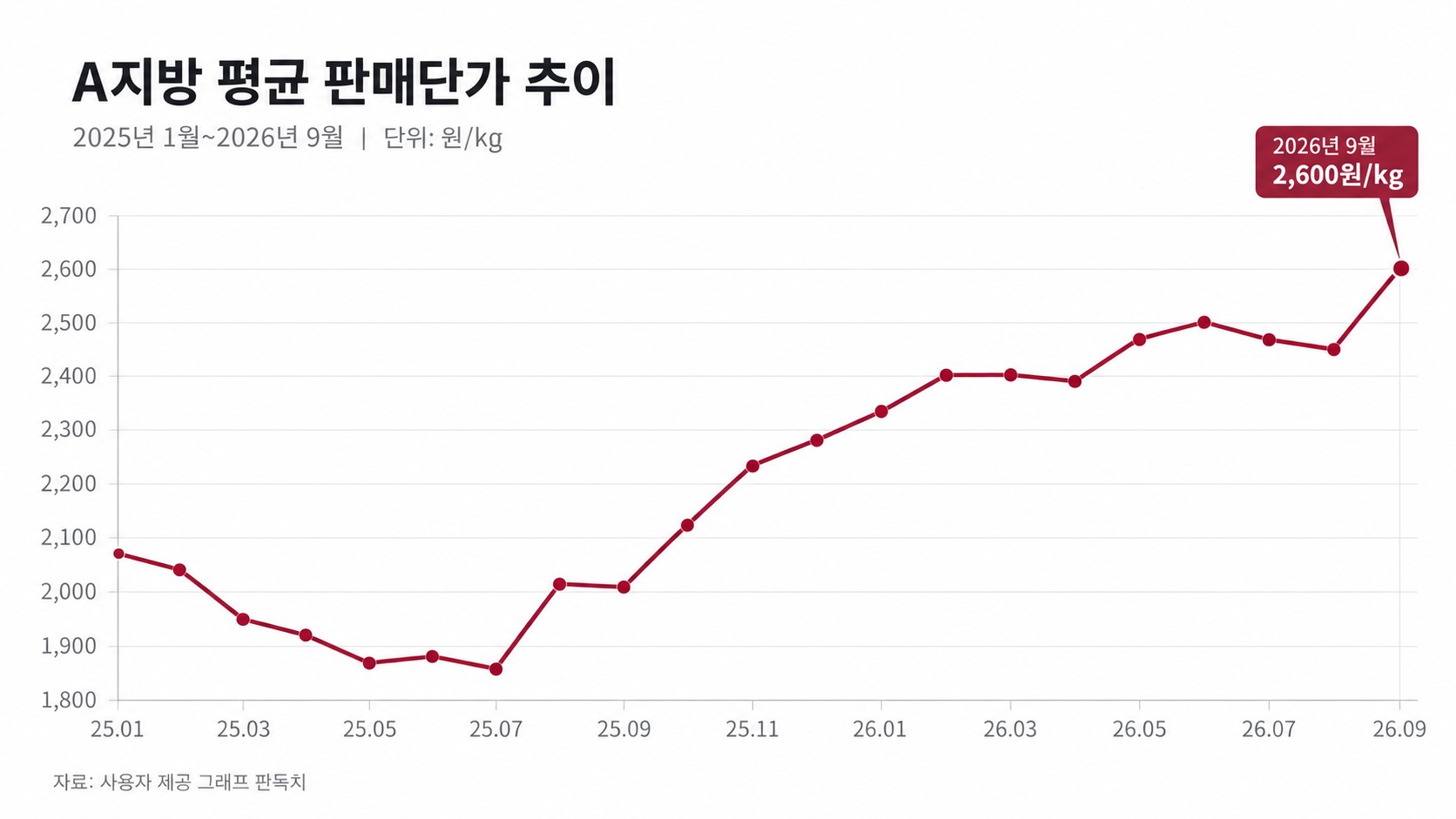
Based on the provided monthly sales price graph, the price of A region dropped to the high 1,800 won range per kg in mid-2025 and then rose from the second half of the year.The average price in September 2026 is approximately 2,600 won/kgThis is about 30% higher than the approximately 2,000 won in September 2025. This figure is an approximation derived from the original graph and should be distinguished from the confirmed exact monthly transaction price.
The number of slaughtered animals remains almost the same... It is difficult to say that the supply of fat has decreased significantly either.
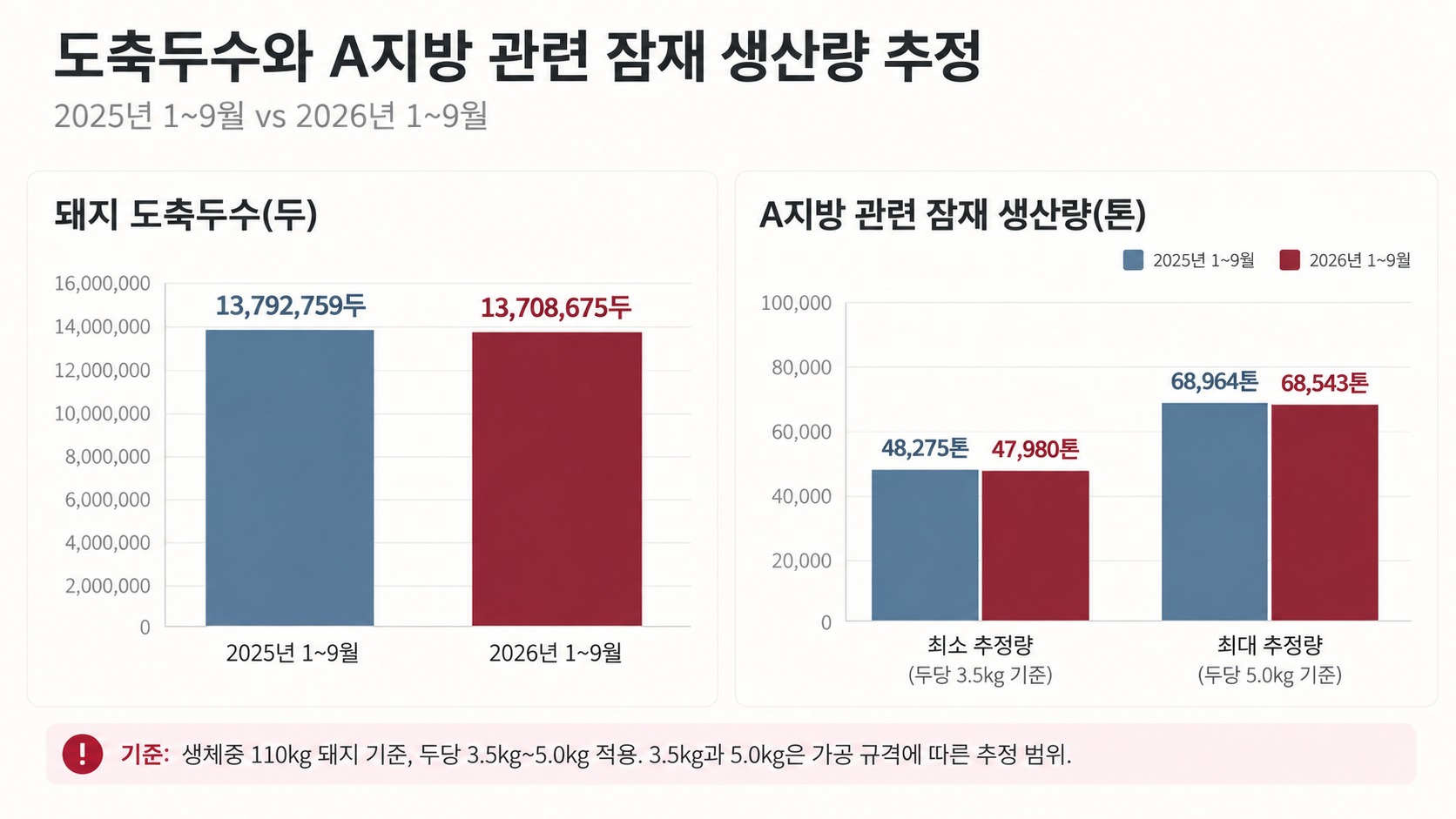
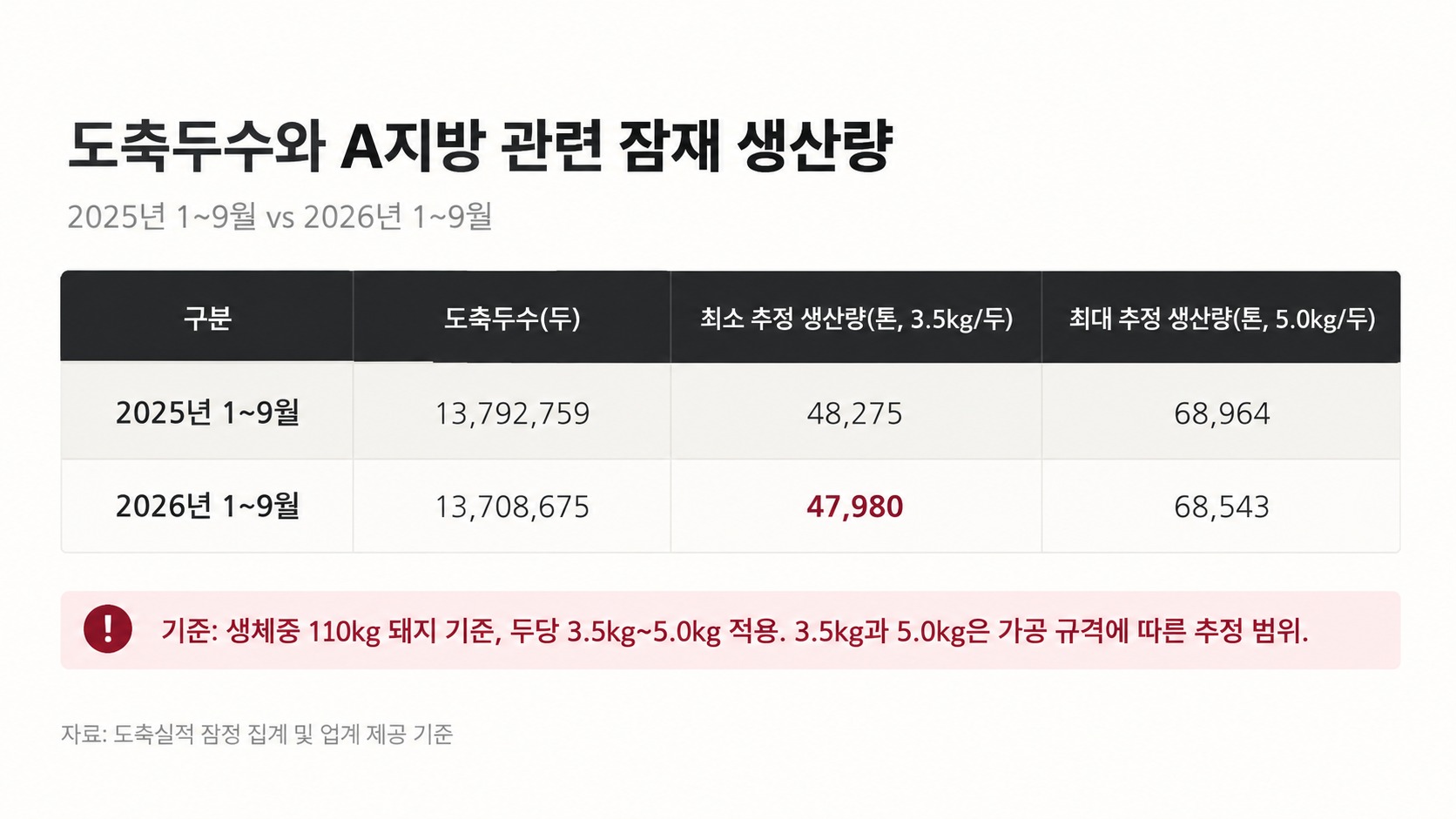
The number of pigs slaughtered domestically decreased by approximately 0.6% from 13,792,759 in January-September 2025 to 13,708,675 in the same period of 2026. The total scale of slaughter remains largely unchanged from the previous year.
Range of yield per head based on a live weight of 110kg pig presented on-site3.5~5.0kgIf simply applied, the potential production volume related to regional areas from January to September 2026 is approximately47,980–68,543 tonsIt is estimated to be... There is no significant difference from the estimate of approximately 48,275 to 68,964 tons for the same period last year.
This range is a calculated value based on different trimming standards for meat cuts. It does not directly represent the actual sales volume or market supply of A-grade fat. Distribution volume varies depending on the trimming methods used by each processor, fat sorting standards, and the proportion of internal consumption versus external sales.
Imported pork fat increased by 33.4%, but domestic A-grade fat prices rose
According to quarantine data on imported livestock products, the import volume of pork fat from January to August 2026 is9,641 tonsAs a result, compared to 7,227 tons in the same period last year.33.4%It increased. It has already exceeded the 2025 annual import volume of 9,061 tons. However, the upward trend in domestic A-region prices continued.
Not all 'pork fat' in import statistics meets the A-grade fat standard desired by domestic meat processing companies. The industry explains that when factors such as exchange rates and transportation costs are taken into account, the price of imported fat can reach 2,500 to 2,700 won per kilogram or even higher. Country of origin labeling, product formulation, frozen storage, and logistics conditions are also factors that make it difficult to substitute domestic products.
thus It is difficult to conclude that the supply and demand of domestic A-grade fat has improved based solely on the fact that import volumes have increased.In reality, you must separately verify the quantity, specifications, and actual transaction prices of alternative local products.
To save Region A, you buy Fuji too… Reversed purchasing relationships
The most important aspect of this supply and demand imbalance isIndustry reports indicate that securing A-grade fat is linked to purchasing domestic Fuji.Some meat packaging companies conduct transactions by requiring the purchase of a certain proportion of hind leg meat along with A-grade fat.
From the perspective of meat processing companies, even if they secure sufficient lean meat raw materials from imports, there is an incentive to purchase additional hind leg meat to supply the domestic A-grade fat essential for product production. In this case, a portion of the trade in domestic hind leg meat is maintained by the necessity of sourcing fat rather than the price competitiveness of the hind leg itself.
A structure is being created where people buy meat along with fat not because they need meat, but to secure fat.
A source involved in the investigation expressed the view that without such linked purchasing, the price of domestic Fuji would have been significantly lower than it is now. They also presented a scenario in which the purchase price, currently at 4,700 to 4,800 won per kg, could have dropped to 3,600 to 3,700 won if it had been determined solely by competition with imported raw meat.However, this is a forecast based on the source's assumptions and is not a confirmed fair price or a definitive prediction of a decline.
The ‘Paradox’ of Rising A-Region Prices Shaking Fuji Market
In the short term, the high price of Grade A fat may be a factor in increasing the sales revenue of meat packaging companies and maintaining linked transactions with hind leg fat. However, if prices continue to rise, the gap in actual purchase prices with imported fat will narrow, increasing the likelihood that large meat processing companies will consider switching their raw materials.
Since product-specific quality standards, country of origin labeling, and supply contracts must be changed, the transition may not occur in the short term. However, if the use of imported fat expands structurally, the incentive to link purchases of Fuji to obtain domestic A-grade fat weakens. This could create additional downward pressure on the Fuji market, where price competition has already intensified due to imported raw meat from Spain and Brazil.

Is the bottleneck in meat processing shifting from raw meat to fat?
Even with diversified sources for raw meat, production plans for processed products such as dumplings and sausages may be constrained if the appropriate fat for the blend cannot be secured. This implies that the available supply of fat could emerge as a new variable determining operating rates and purchasing strategies.
However, it is still necessary to verify how many cases there are where actual factory production has decreased due to a shortage of local produce, and what proportion of total Fuji transactions is accounted for by linked purchasing from Region A. This analysis explains market risks by connecting quarantine records, price trends, and on-site reporting, and does not definitively generalize the transaction conditions of a specific company.
Ultimately, the key point to watch in the domestic Fuji market is not just how high the A-region price rises.When and how quickly meat processing companies switch to imported fatThis could determine the next direction of domestic Fuji prices. In a market where meat is abundant but fat is scarce, attention must be paid to how long the fat currently supporting the Fuji will remain as a pillar of support.
dataAnimal and Plant Quarantine Agency import livestock product inspection results (September 2026), user-provided monthly sales price graph for Region A, pig slaughter count tally, industry raw meat supply and demand coverage.
Caution regarding statistical interpretationThe 2025 figures for the comparison of Jeonji and Fuji import volumes represent the annual total, while the 2026 figures represent the cumulative total from January to September. The average selling price in Region A is an approximation of the reading from the original graph, and the production volume is an estimate based on the assumption of output per head.
Scope of coverage and analysisThe scenarios regarding Fuji-linked purchasing and the substitution of imported regional products are analyses and forecasts based on industry coverage. They do not definitively represent actual contract ratios or the extent of price declines.
- #수입육
- #축산물
- #브랜드
- #유통
Related Content
DEEP DIVE
German Pig Prices 'Plunge'... 70 Euro Loss on Every Pig Sold
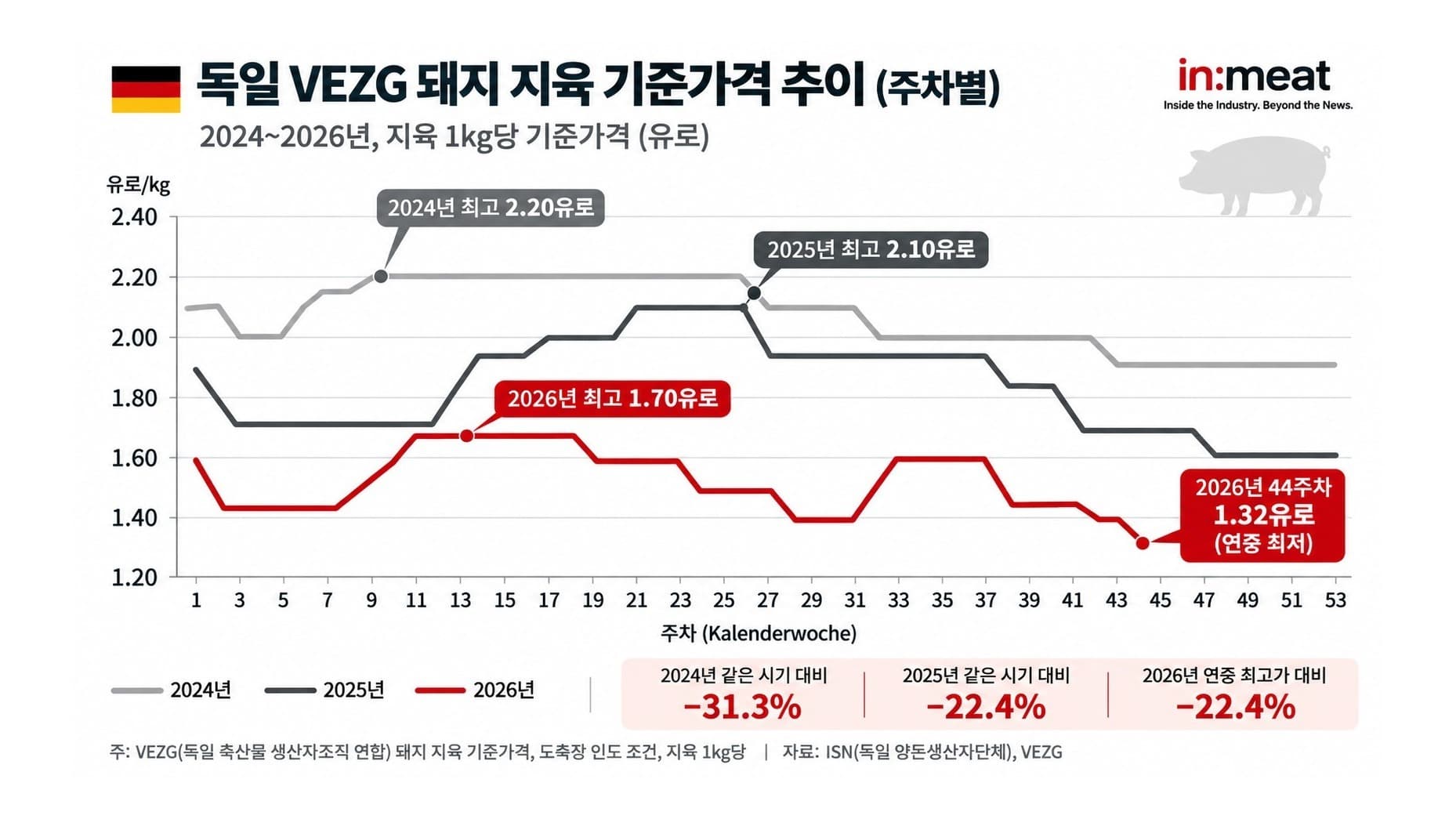
The management crisis for pig farms is deepening as the standard price of pork carcasses in Germany has fallen to 1.32 euros per kilogram. Producer organizations estimated that, taking into account total production costs, a loss of about 70 euros per pig is incurred.
2026.10.31
DEEP DIVE
The Hanwoo meat processing business driven into a struggle for survival—is there no way out?
The Hanwoo beef processing industry stands at a crossroads of survival. The burden of maintaining existing production facilities and personnel is increasing as slaughter volumes have followed a decline in the number of cattle raised. On top of this, industry insiders explain that the business environment for processing companies is deteriorating due to a confluence of factors, including rising raw meat prices, intense competition in the market for specific cuts, and market expansion moves by major players.
2026.10.26
DEEP DIVE
“We must buy it to survive” … Restaurant industry wages ‘raw material procurement war’ amid U.S. short rib shortage
The atmosphere surrounding U.S. beef short ribs in the domestic meat market is becoming increasingly volatile. Companies that had been delaying purchases due to rising import prices are now scrambling to secure raw materials, even if it means accepting the high costs. For restaurant businesses that sell ribs as their main menu item, the ability to continuously secure the necessary supply has emerged as a greater concern than the cost itself.
2026.10.21