
DEEP DIVE
The Hanwoo meat processing business driven into a struggle for survival—is there no way out?
Hanwoo slaughter recorded 990,000 heads in 2024, projected to decrease to 827,000 heads by 2028
We must be in the top 20 in the meat processing industry to survive.
This is what an industry insider who has been working in the Hanwoo beef processing business for 35 years recently said while forecasting the future of the Hanwoo beef processing market. Rather than actually meaning that only the top 20 companies will survive, this remark reflects the sense of crisis felt by small and medium-sized meat processing companies in an increasingly competitive market.
The Hanwoo beef processing industry stands at a crossroads of survival. The burden of maintaining existing production facilities and personnel is increasing as slaughter volumes have followed a decline in the number of cattle raised. On top of this, industry insiders explain that the business environment for processing companies is deteriorating due to a confluence of factors, including rising raw meat prices, intense competition in the market for specific cuts, and market expansion moves by major players.
Recently, the sense of crisis in the industry is intensifying as reports spread that not only small-scale meat processing companies but also mid-sized firms equipped with substantial production facilities and processing capabilities are being put up for sale.This suggests that the business structure of the entire meat processing industry is changing, going beyond mere management difficulties faced by small businesses.
The problem is that these difficulties may not be limited to a temporary downturn. With the decline in Hanwoo supply projected to continue for a significant period, the meat processing industry is also facing a situation where it must re-examine its existing business structures.

Hanwoo slaughter projected to peak in 2024 and decline until 2028
The starting point of the crisis facing the Hanwoo meat processing industry is the decrease in the supply of raw meat.
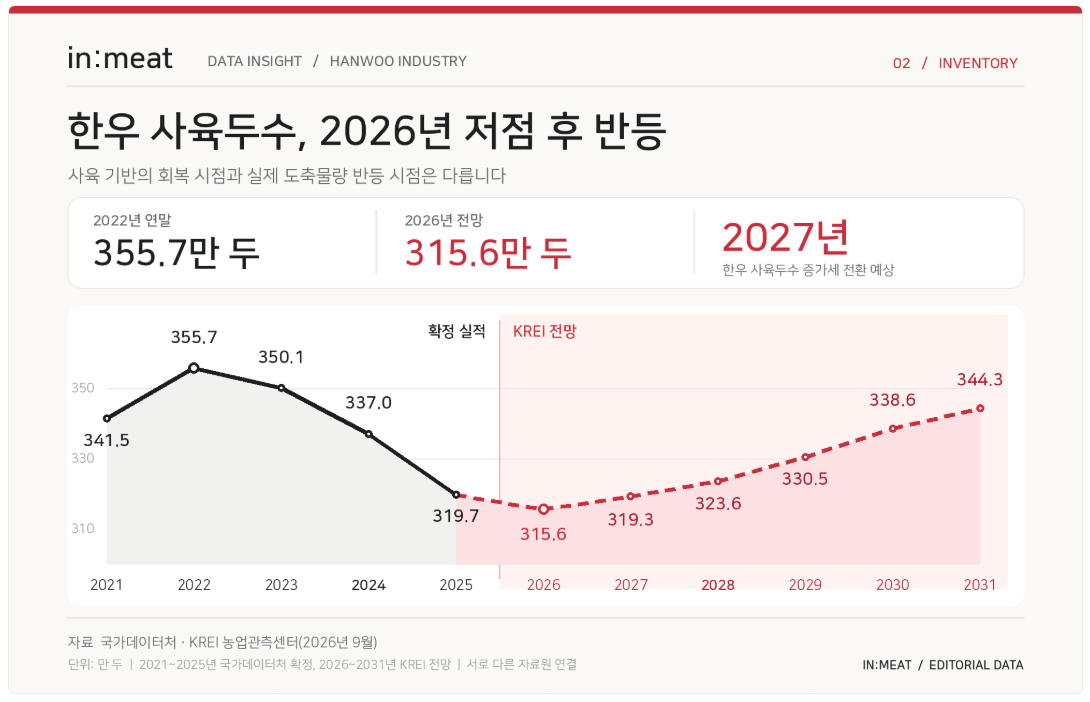
According to the National Data Agency, the number of Hanwoo cattle began to decline after recording 3.557 million head at the end of 2022. It decreased to 3.501 million head in 2023 and 3.37 million head in 2024, and recorded 3.197 million head at the end of 2025. As of September this year, the number of cattle was approximately 3.18 million head, a 4.5% decrease compared to the same period last year.
Despite a decrease in the number of cattle raised, the number of Hanwoo slaughtered continued to rise for some time. According to grading statistics from the Korea Animal Products Quality Evaluation Institute, the number of slaughtered Hanwoo, which stood at 794,000 in 2021, increased to 869,000 in 2022 and 929,000 in 2023, reaching approximately 990,000 in 2024.
As the number of cattle raised decreased due to a combination of factors—such as a decline in farmers' willingness to raise cattle following falling Hanwoo prices and an increase in the shipment of cows—a phenomenon occurred where the slaughter volume actually increased.
However, in 2025, the number of slaughtered animals was set at approximately 948,000, a 4.3% decrease from the previous year, marking the beginning of a full-scale reduction in supply.
The future outlook is also burdensome for the meat processing industry. According to the Hanwoo outlook released by the Korea Rural Economic Institute (KREI) last September, the number of Hanwoo slaughtered this year is expected to be approximately 864,000, a decrease of 8.8% from the previous year. It further projected a decline to 828,000 in 2027 and 827,000 in 2028.
Compared to 2024, the annual slaughter volume in 2028 is expected to decrease by approximately 16.5%, or 163,000 head.

Graph ① Trends in Hanwoo Slaughter Volume and Forecast to 2031
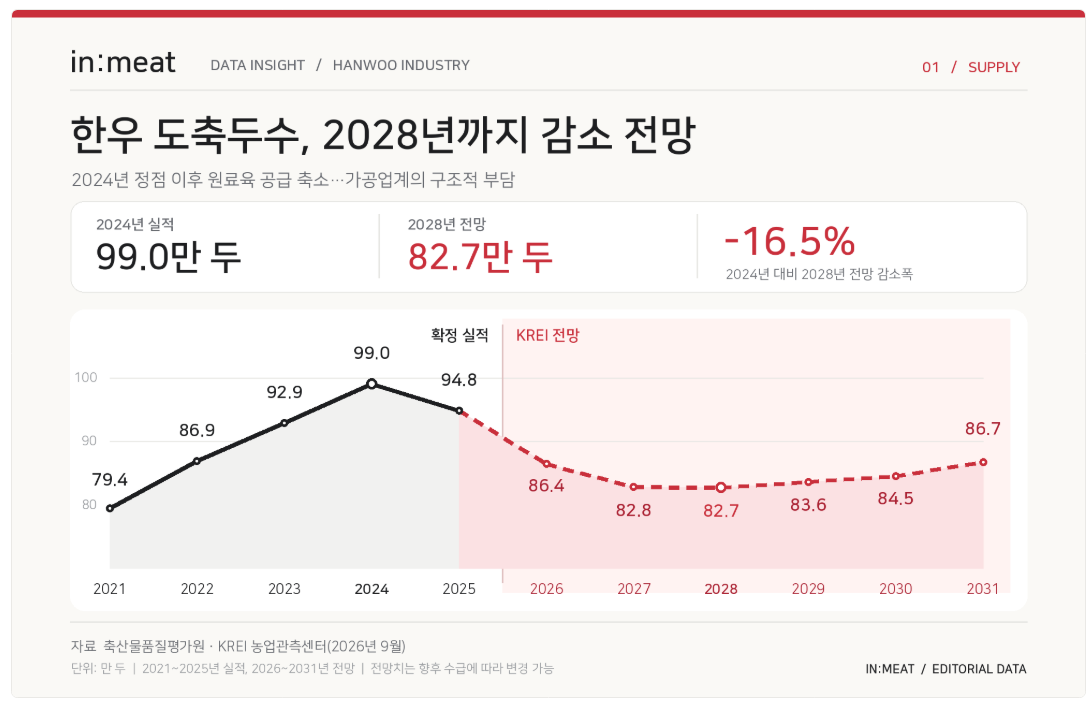
Even if the number of slaughtered animals turns upward starting in 2029, the pace of recovery is expected to be gradual. The number of slaughtered animals projected by the research institute for 2031 is 867,000, which is still about 12.4% lower than in 2024.
The number of cattle raised is projected to shift to an upward trend starting in 2027. However, since Hanwoo cattle require a significant amount of time from calf production to fattening and shipment, there is a time lag before an increase in the number of cattle leads to an actual increase in slaughter volume.
Graph ② Trends in Hanwoo Cattle Raised and Forecast to 2031
The number of cattle to be processed is decreasing, but facilities and manpower remain the same.
The reason the decrease in Hanwoo slaughter volume is burdensome for the meat processing industry is that it is difficult to adjust existing production facilities and personnel in the short term.
Meat processing companies purchase carcasses from slaughterhouses, trim and package them by cut, and then sell them to distributors, meat retailers, and restaurants. This process incurs significant fixed costs, including trimming personnel, refrigeration and freezing facilities, and production equipment.
If the volume of slaughtered animals decreases, the processing volume for each company may also decrease, but labor costs and facility maintenance costs do not decrease in proportion to the reduction in volume.
In particular, companies equipped with production facilities of a certain scale or larger inevitably face a greater burden of processing costs per head as factory utilization rates decrease.
Explaining the current difficulties, an industry official pointed out, "The core issue is that while the number of pigs has decreased, meat processing remains the same."
He explained that companies that had expanded their facilities and workforce in line with the increase in processing volume in the past are facing difficulties as they confront a decrease in supply. He noted that while production facilities and personnel should be adjusted accordingly if the number of cattle to be processed has decreased, this is not realistically easy.
In particular, companies that have embarked on new facility investments or large-scale expansions may face the double burden of recouping investment costs and maintaining factory utilization rates.
It is impossible to conclude whether the production capacity of Hanwoo meat processing facilities nationwide is actually in a state of overcapacity based solely on currently available slaughter statistics. To make such a determination, factors such as the number of companies, facility size, processing capacity, and actual operating rates must be examined together.
However, it is clear that if the decline in slaughter volume continues in the future, the management burden on companies maintaining their existing production capacity could increase.
From small businesses to mid-sized firms put up for sale… Sense of crisis spreading through the meat processing industry
Industry insiders say that these difficulties are also manifesting as moves by some companies to restructure their businesses and sell off their facilities.
While in the past the management difficulties of small-scale meat processing companies were the primary concern, recently even mid-sized companies that have secured production capacity through significant facility investments are being put up for sale.
Referring to the moves to sell meat processing facilities in the metropolitan area and regional regions, an industry insider stated, "Mega-sized meat processing plants are now emerging."
In particular, the report highlighted a case where a large-scale meat processing facility, built with an investment of tens of billions of won, was put up for sale at a price significantly lower than the original investment, yet it was difficult to find a buyer.
However, these examples are based on explanations from industry insiders, and further verification is required regarding whether individual companies are actually pursuing sales and their desired sale prices.
It is worth noting the characteristics of meat processing facilities. Unlike general factories, meat processing facilities are constructed for specific purposes, including refrigeration and freezing equipment, hygiene management facilities, and shaping and packaging equipment. Depending on location and licensing conditions, there may be restrictions on converting to other business sectors.
Therefore, even if you attempt to sell the facility, potential buyers capable of utilizing it may be limited, and there is a possibility of facing difficulties in recovering existing investment costs.
This shows that meat processing companies may face a situation where they have to liquidate not only their operations but also the production facilities and business foundations they have accumulated over a long period.
In particular, on-site testimonies indicating that not only small businesses but also mid-sized meat processing companies are entering the sale market are noteworthy, as they suggest that the struggle for survival in the Hanwoo meat processing industry is not a problem limited to companies of a specific size.
Processing to secure supply, and selling at a loss
The decrease in the supply of raw meat makes competition among meat processing companies more complex.
Meat processing companies must secure a certain volume of work to maintain their existing facilities and workforce. However, if the total volume of slaughtered meat in the market decreases, fierce purchasing competition among companies for the limited supply of raw meat is inevitable.
The problem is that even if raw meat is secured, it is difficult to make a sufficient profit.
While the cost of purchasing carcasses increases due to rising Hanwoo prices, the selling price of cut meat does not fully reflect the increase in costs.
In particular, when purchasing a whole animal, not only grilling cuts such as sirloin, tenderloin, and striploin must be sold together, but various other cuts like rump, round, shank, and ribs must also be sold. Given that demand for specific cuts is inconsistent, sluggish sales of certain products result in an inventory burden.
An actual industry insider shared a case where sirloin, which was sold for 70,000 won in normal transactions, was supplied for 58,000 won through other channels.
While this cannot be viewed as a general market price given it is an individual transaction, it illustrates the sales pressure felt by meat processing companies.
The official explained that there are business owners who are trying to secure processing volumes even at a loss, as they find it difficult to cope with the situation where employees are unable to work and are resting.
Ultimately, this means falling into a vicious cycle where not processing leads to a drop in factory utilization rates, while excessive processing increases the burden of sales.
From the perspective of meat processing companies, the inability to secure a reasonable profit margin between the purchase price of raw meat and the selling price of cut meat may be a greater problem than the high price of cattle itself. Under such a management structure, the profitability of meat processing companies does not necessarily improve even if the price of Hanwoo rises.
Market expansion by large companies… Will small and medium-sized meat processing companies lose ground?
Another change that the Hanwoo meat processing industry is concerned about is the possibility of market restructuring centered on large companies.
Industry officials assessed that the competitive environment for existing small and medium-sized enterprises (SMEs) is changing as large distribution companies and meat processing firms expand their market participation.
Large companies that have secured business scopes ranging from the purchase of raw meat to processing and distribution have the advantage of being able to leverage their financial resources and sales networks.
On the other hand, small and medium-sized meat processing companies often operate with relatively limited capital and clients. This disparity is likely to have a more significant impact during periods of reduced supply than during times when raw meat supply is sufficient.
"An industry official expressed concern that the influence of large companies could grow even further in the future, stating, 'The number of companies has dropped and is shifting to one side.'"
He raised the possibility that the Hanwoo meat processing market could be reorganized around a few large companies, emphasizing that small and medium-sized enterprises must re-examine their business structures to survive.
However, objective verification through individual company processing volumes and sales performance is necessary regarding whether and at what speed large companies are actually expanding their market share.
What is important is not the mere existence of large companies, but rather how small and medium-sized enterprises can secure competitiveness in a market where supply volume is shrinking.
“Bigger factories don’t guarantee victory”… In-house distribution networks are a condition for survival
What industry insiders repeatedly emphasized during this coverage is the importance of in-house distribution networks.
He pointed out that a company's competitiveness should not be evaluated solely by the size of its production facilities, stating, "Winning because the factory is big? That is not the way to win."
In order for a meat processing company to operate a stable business, it must secure not only the ability to process raw meat but also the capability to sell the processed meat parts.
In particular, business structures that receive and process work volume from specific distributors or large clients can be affected by the clients' business conditions and changes in contracts.
This is because if clients reduce orders or terminate contracts, it becomes difficult to maintain the operating rate even if one owns a factory.
On the other hand, companies that have secured their own sales networks can sell cut meat through various clients and establish distribution strategies tailored to the demand for each cut.
Of course, establishing an in-house distribution network requires significant capital and sales capabilities. Therefore, it may not be a realistic alternative for all small and medium-sized enterprises to build their own large-scale distribution networks.
The important thing is to secure stable sales channels tailored to the company's size and circumstances and reduce dependence on specific clients.
This suggests that the competitiveness of the Hanwoo meat processing industry is shifting from simply the number of cattle that can be processed to the efficiency of processing and the ability to sell stably.
Scaling Up Is Not the Only Answer… Potential for Specialization and Collaboration
Then, what survival strategies can small and medium-sized Hanwoo meat processing companies choose?
First, it is necessary to objectively assess the operating rate and profitability of existing production facilities.
If excessive purchasing of raw meat to increase processing volume actually leads to losses, maintaining an appropriate processing volume and managing costs should be prioritized over expanding production scale.
In particular, companies considering new facility investments or expansions must fully consider future slaughter volumes, the feasibility of securing raw meat, and actual sales outlets.
A specialization strategy that leverages the unique strengths of small and medium-sized enterprises can also be an alternative.
While large companies have strengths in large-scale processing and nationwide distribution, small and medium-sized enterprises can secure differentiated competitiveness through customized specifications for each client, small-batch orders, specialized butchering of specific cuts, and localized supply.
It is also important to diversify sales channels for different cuts. Rather than relying solely on cuts for grilling, it is necessary to establish a trading network capable of stably selling products produced from a single animal, such as meat and by-products.
Collaboration among companies is also worth considering. This is a way for small and medium-sized enterprises to reduce costs through joint logistics, facility utilization, or specialization in specific processes, rather than each operating all facilities and logistics systems individually.
A structure in which large distributors and small and medium-sized meat processing companies cooperate by leveraging each other's business characteristics can also be explored.
Table. Major Management Burdens and Survival Strategies of Hanwoo Meat Processing Companies
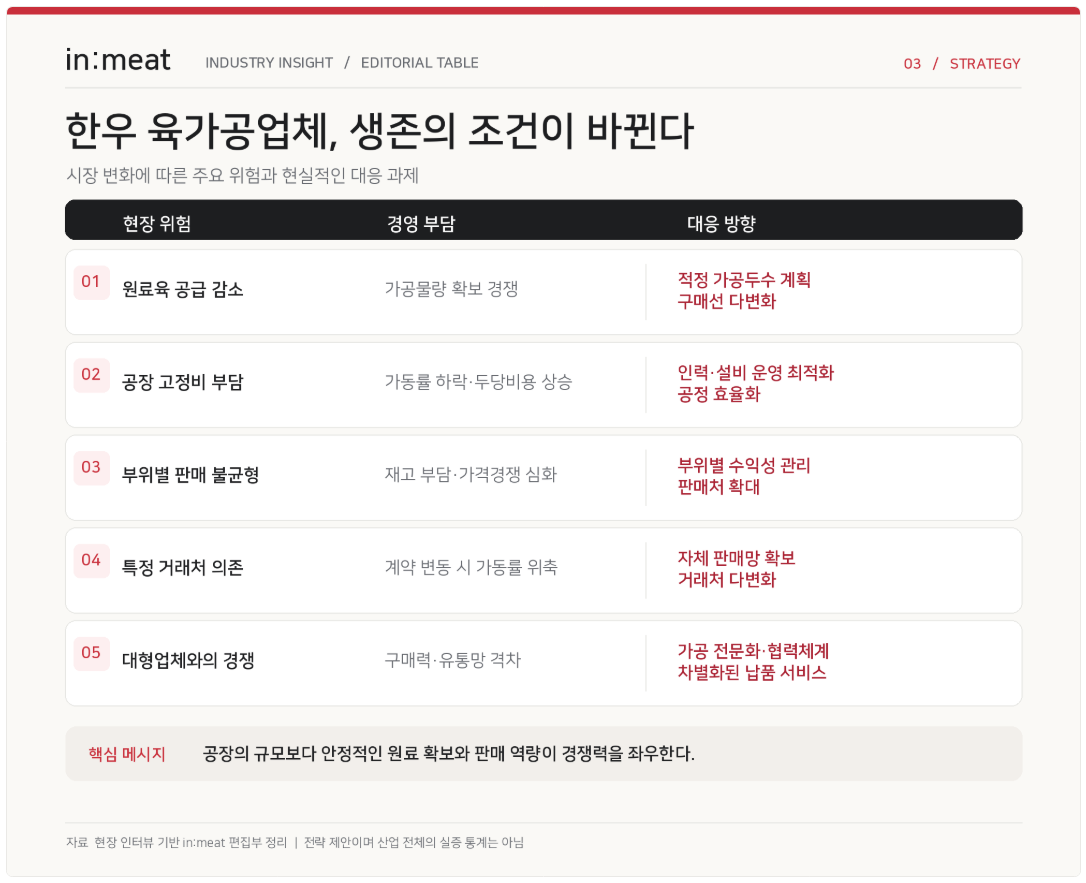
However, for this approach to lead to actual business improvement, quality control, transaction stability, and cost reduction effects must be thoroughly reviewed.
It is time to discuss the coexistence of large corporations and SMEs.
There is no need to view the market restructuring of the Hanwoo beef processing industry simply as a confrontation between large corporations and small and medium-sized enterprises.
While corporate consolidation may occur in the process of increasing industrial efficiency and competitiveness, not all companies must compete in the same way.
This is because there are areas where large and small businesses can leverage their respective strengths to divide roles and cooperate.
In this report, an industry official emphasized that the issue of coexistence between large corporations and small and medium-sized enterprises (SMEs) can no longer be ignored.
He stated that we must openly discuss the realities of the industry and find a way to coexist based on objective data, saying, “Someone needs to speak honestly about this.”
To discuss the future of the Hanwoo meat processing industry, it is necessary to first objectively examine how the decrease in supply is affecting the management of individual companies and how the market structure of large and small businesses is changing.
In addition, efforts are required to enhance the transparency of market information and improve transaction efficiency so that meat processing companies can make rational decisions regarding raw meat purchasing and sales prices.
The conditions for companies to survive are changing.
The changes facing the Hanwoo meat processing industry are not merely a matter of recession.
In the past, an important growth strategy was to expand production facilities and increase processing volume based on the increase in the number of Hanwoo cattle raised and slaughtered.
However, it is highly likely that market conditions will change in the future.
According to the mid-to-long-term forecast by the Korea Rural Economic Institute, the volume of Hanwoo slaughtered is expected to decrease until 2028 and then gradually recover starting in 2029.
Meanwhile, meat processing companies must compete in an increasingly fierce market while operating their production facilities and workforces to match the reduced supply of raw meat.
Reports from the field that even mid-sized meat processing companies, extending beyond small firms, are entering the acquisition market suggest that there may not be enough time to respond to these changes.
An industry insider advised junior business owners to make decisions based on future market changes rather than blindly holding out or expanding their business scale.
He stated, “You must distinguish between when to step back and when to take on a challenge,” warning that maintaining a business based solely on vague expectations could lead to even greater losses.
Of course, it cannot be concluded that the Hanwoo meat processing market will necessarily be restructured into a system where only a few large companies survive. Small and medium-sized enterprises also have the potential to secure competitiveness based on specialized processing technology, stable trading networks, and flexible production systems.
However, it is clear that it is difficult to solve the current management problems by simply waiting for past slaughter volumes to recover.
The way out for the Hanwoo meat processing industry may not simply lie in building larger factories or securing more cattle.
The key factor determining which companies will survive in the future will not be the size of the factory, but whether they possess a production structure and sales network capable of generating profits even amidst a changed supply environment.
cautionReferences regarding the sale of meat processing facilities are based on testimony from industry insiders and do not constitute official confirmation of whether a specific company has sold such facilities. Changes in market share and the extent of oversupply of meat processing facilities nationwide also require separate verification.
Statistical data· National Data Center "Livestock Trends Survey", Korea Animal Products Quality Evaluation Institute Grading Statistics, Korea Rural Economic Institute "September 2026 Hanwoo Outlook"
raw materials·KREI September 2026 Hanwoo Observation (PDF)·Press Release on the Q3 2026 Livestock Trends Survey
The number of Hanwoo slaughtered is based on the number of graded cattle, and figures for 2026 onwards are projections by the Korea Rural Economic Institute and are subject to change.
- #축산물
- #유통
Related Content
DEEP DIVE
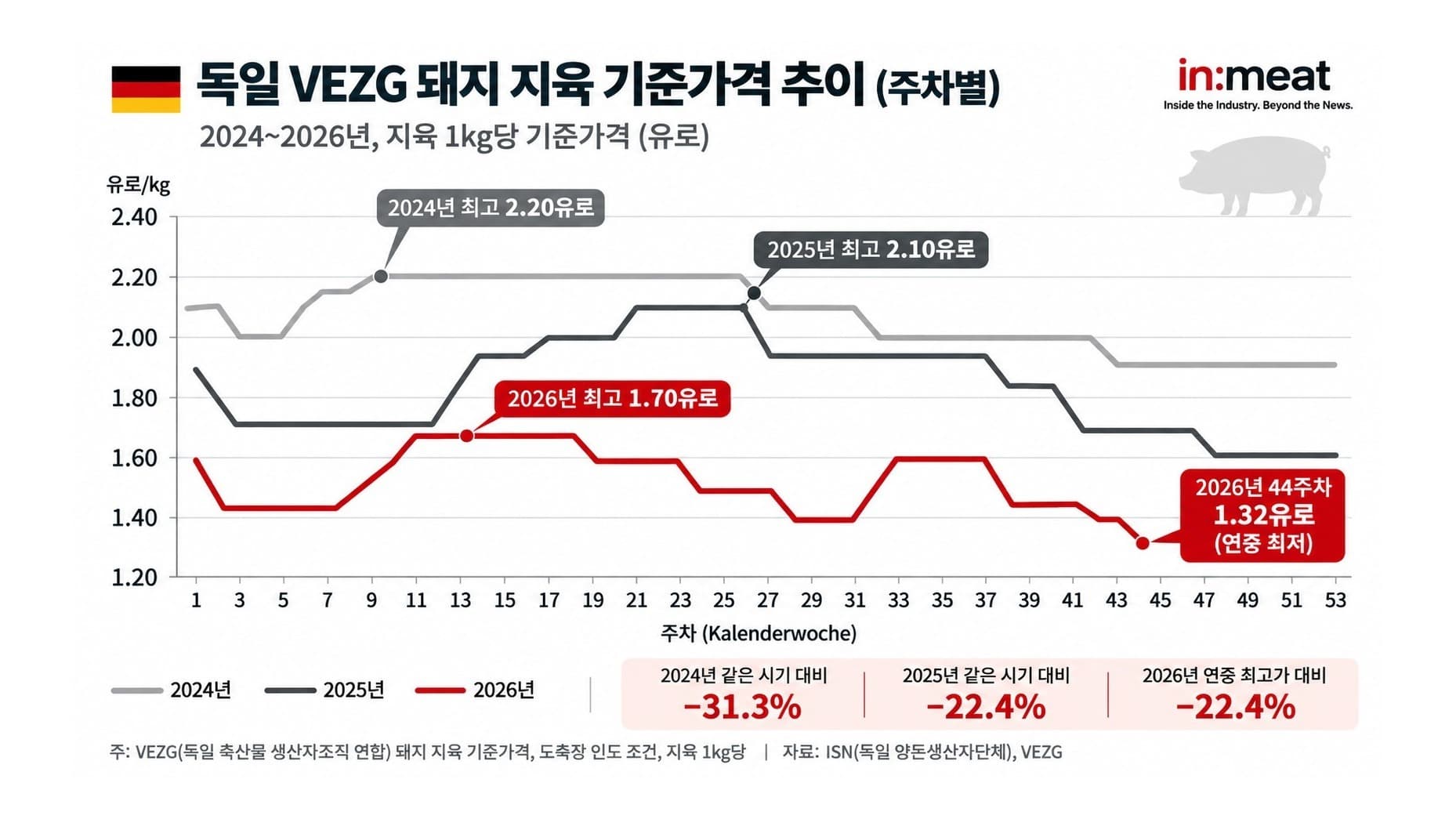
German Pig Prices 'Plunge'... 70 Euro Loss on Every Pig Sold
The management crisis for pig farms is deepening as the standard price of pork carcasses in Germany has fallen to 1.32 euros per kilogram. Producer organizations estimated that, taking into account total production costs, a loss of about 70 euros per pig is incurred.
2026.10.31
DEEP DIVE
“We must buy it to survive” … Restaurant industry wages ‘raw material procurement war’ amid U.S. short rib shortage
The atmosphere surrounding U.S. beef short ribs in the domestic meat market is becoming increasingly volatile. Companies that had been delaying purchases due to rising import prices are now scrambling to secure raw materials, even if it means accepting the high costs. For restaurant businesses that sell ribs as their main menu item, the ability to continuously secure the necessary supply has emerged as a greater concern than the cost itself.
2026.10.21
DEEP DIVE
Hanwoo Exports Up 60%, But Market Concentration and Quarantine Barriers: One Hurdle After Another
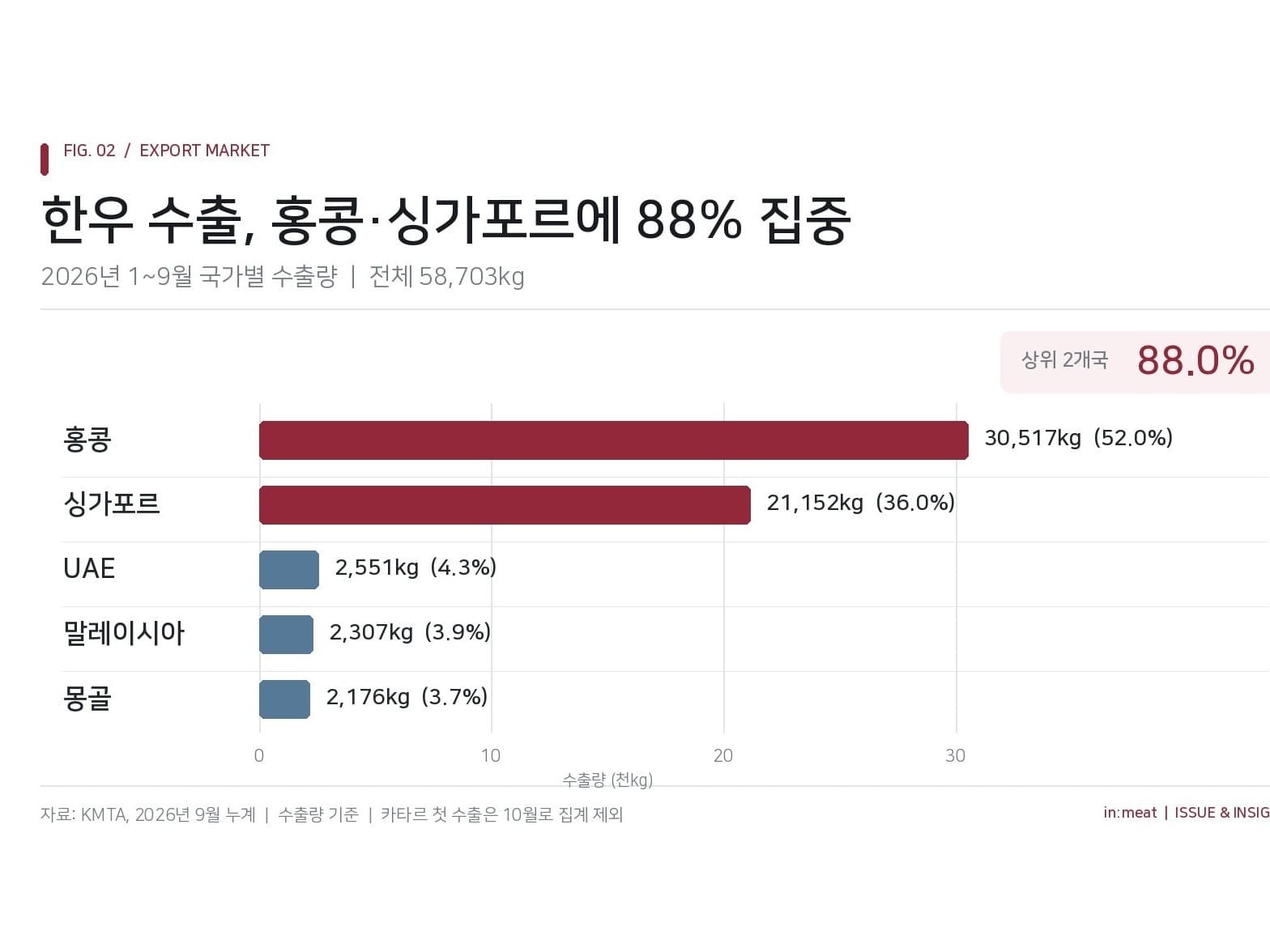
Hanwoo exports are increasing rapidly. The government has also presented a plan to link Hanwoo with the global K-food export promotion system. However, 88% of export volume is concentrated in the two markets of Hong Kong and Singapore, and on-site issues such as slaughter and quarantine procedures for export and restrictions on market access due to livestock diseases remain unresolved.
2026.10.13