
DEEP DIVE
Series | Pig's Head Meat, Discovering New Possibilities
(Part 1) Prices of Domestic Heads and Offal Up 77% in 4 Years… The Price Tag of the Pig Head Market Has Changed
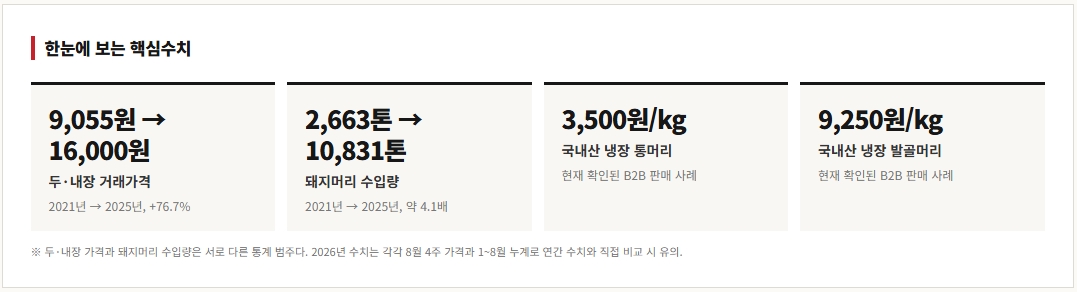
How much does a pig's head cost? When you actually look closely at the market, it is difficult to answer this question with a single price.
At the slaughtering stage, a price is established for the head and offal bundled together, while in the distribution market, separate prices exist for raw whole heads and deboned heads. When further subdivided into cuts such as cheek meat, neck meat, and brisket, entirely different price tags follow.
The same applies to imported products. While whole heads are imported, boneless "mask" forms are distributed, and even specific body parts like cheek meat are traded as imported goods.
Ultimately, the current pig head market is more about ‘how much a head costs’ than
It is closer to a market where ‘in what state and at what stage it is traded’ determines the price.
This change was also evident in the results of a comparison by in:meat of domestic pork by-product prices, pig head import volumes, and the sales prices of currently distributed domestic and imported products over the past 10 years.
Tofu and offal stocks, which had fallen to the 9,000 won range, changed direction starting in 2022.
According to the market prices of pork by-products from the Korea Meat Export Association, the transaction prices for heads and offal generally fluctuated between 10,000 and 11,000 won per head from 2016 to 2019. In 2020, it fell to 9,442 won, and in 2021, it dropped to 9,055 won.
However, the trend changed starting in 2022. In 2022, it rose to 11,335 won, a 25.2% increase from the previous year; it went up to 13,092 won in 2023, 13,927 won in 2024, and reached 16,000 won in 2025. By the fourth week of August 2026, it had climbed to 18,000 won. Comparing 2021 and 2025, this represents a 76.7% increase over four years.
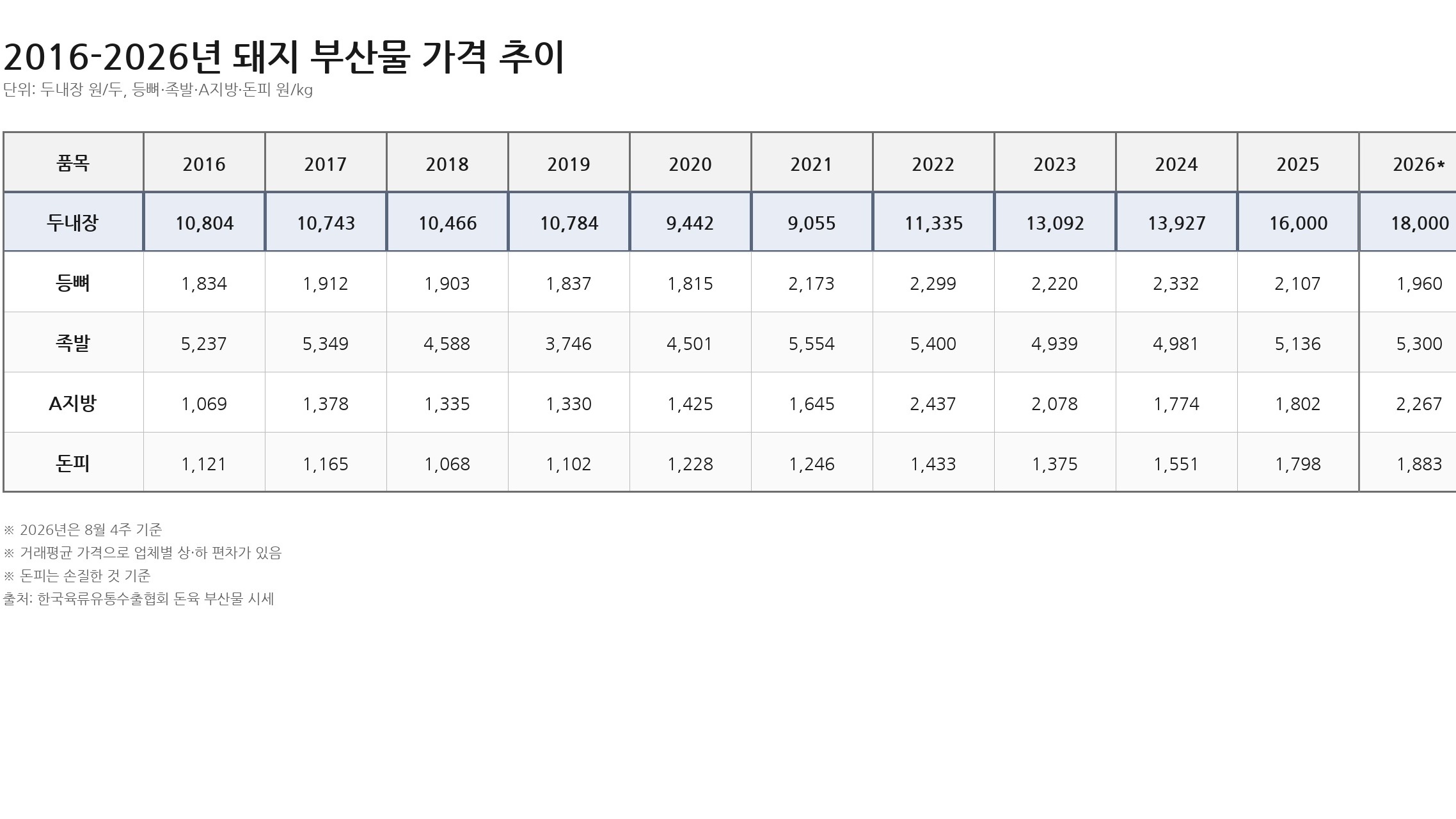
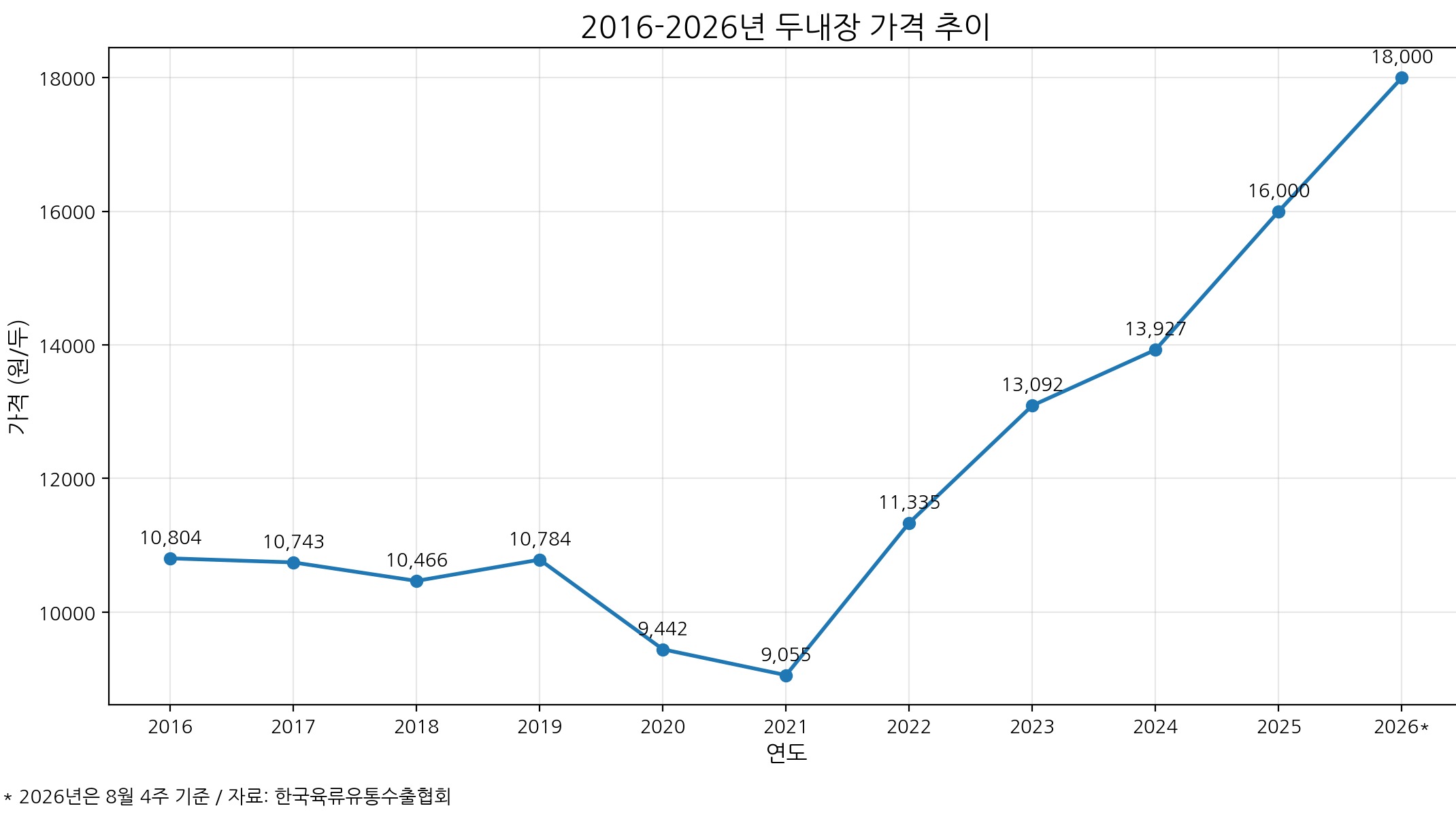
The price of 18,000 won in the fourth week of August 2026 is about 99% higher than the annual average price in 2021. However, it is not appropriate to describe this as the price having "exactly doubled over five years." This is because the 2021 figure is an annual average, whereas the 18,000 won in 2026 is the price at a specific point in time.
There is one more thing that must be distinguished. The head and offal mentioned here do not refer to the standalone transaction price of a single pig's head.
It is a trading unit for by-products including the head and internal organs.
Therefore, the price of the head and offal cannot be regarded as the price of the whole pig head.
Not all by-products rose together.
If the price increase of heads and offal was simply due to a general rise in livestock product prices, a similar trend should have been observed in other by-products. However, the actual figures were different.
Comparing 2021 and 2025, the price of pork backbones fell by approximately 3%, from 2,173 won to 2,107 won per kg. Pig's trotters also decreased by about 7.5%, from 5,554 won to 5,136 won. A-grade fat rose by 9.5%, and pork skin increased by 44.3%. During the same period, the growth rate for heads and offal was 76.7%.
In other words, it is difficult to explain the movements of heads and offal solely by rising costs that apply to all by-products, such as labor, logistics, and processing fees. Further investigation into the by-product processing and distribution sites is required to determine the cause of the price shift.
More was imported, and domestic prices for heads and offal also rose.
Another reason why price movements cannot be explained solely by a simple supply shortage is the volume of pig head imports.
According to the Animal and Plant Quarantine Agency's export and import status by item and country, domestic imports of pig heads amounted to approximately 2,663 tons in 2021. Subsequently, the figures were recorded at 5,142 tons in 2022, 5,868 tons in 2023, and 5,344 tons in 2024, increasing to 10,831 tons in 2025. This represents about 4.1 times the level in 2021. In 2026, approximately 8,946 tons were imported in the first eight months alone.
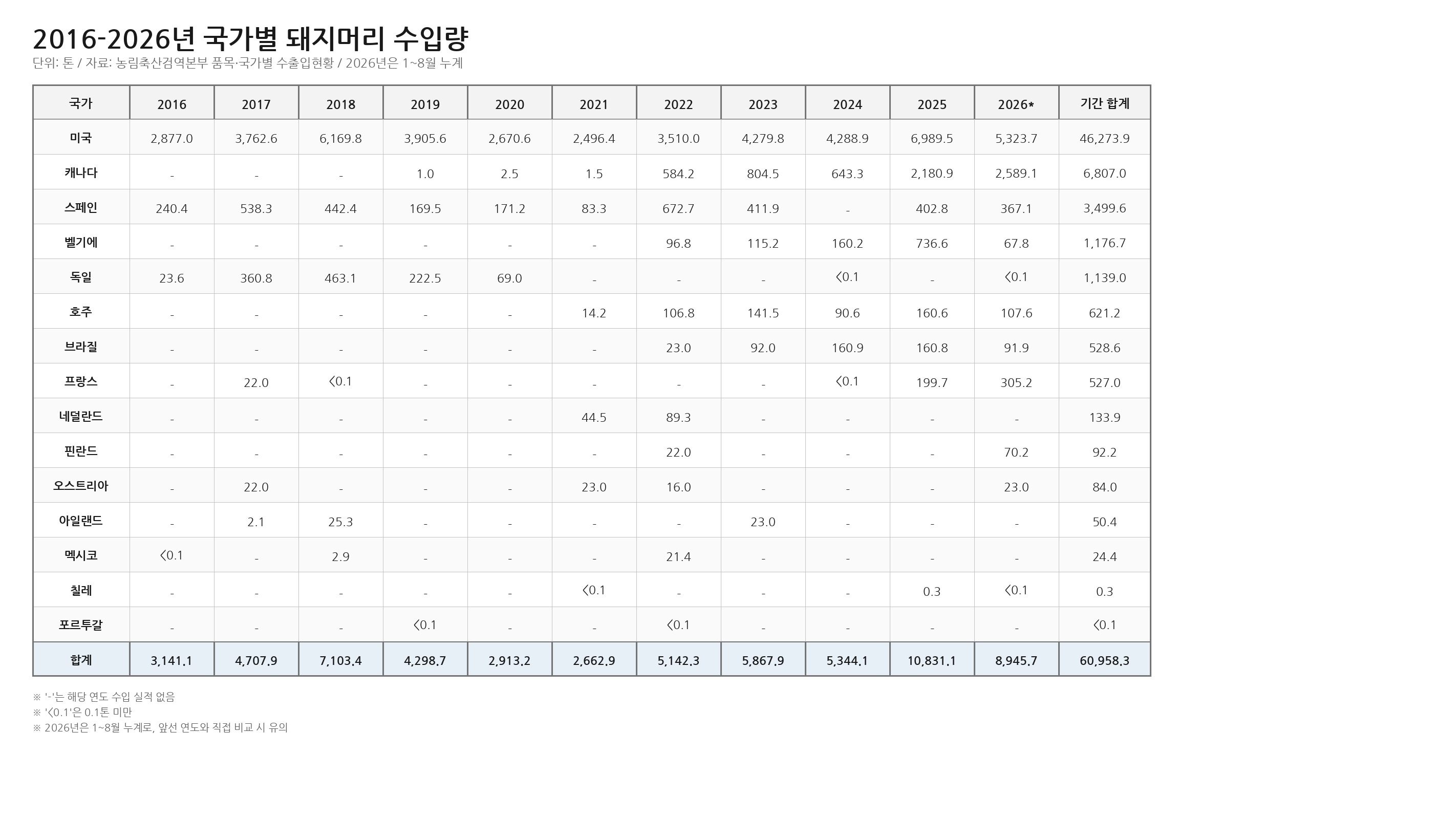
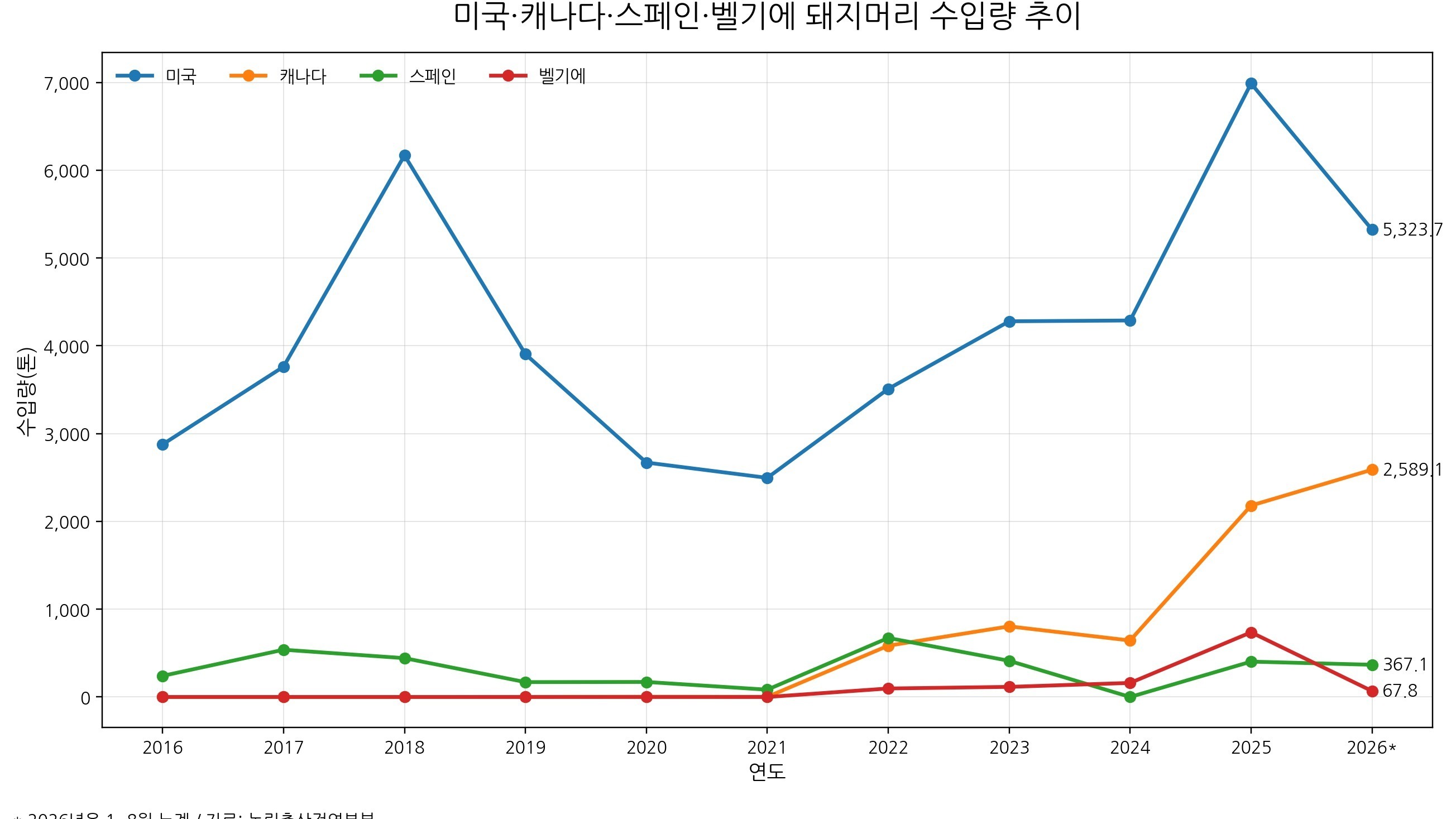
Interestingly, domestic prices for pig heads and offal also rose during this period. The price of pig heads and offal was 9,055 won in 2021, but it was 16,000 won in 2025. This indicates that the upward trend in domestic prices for pig heads and offal occurred simultaneously with a significant expansion in pig head imports.

Domestic whole head 3,500 won/kg… 9,250 won/kg after deboning
Looking at domestic pig head products currently in circulation reveals another characteristic of the pricing system.
According to sales prices on the B2B livestock distribution platform Meatbox, a product of three domestic chilled whole pig heads, totaling 15kg, is being sold at 3,500 won per kg. A product of five chilled deboned pig heads, each weighing approximately 2kg and totaling 10kg, is priced at 9,250 won per kg.
On the same platform, pork head brisket, also known as cheek jowl, is being sold at 14,000 won per kg for bulk products and 16,334 won per kg for 300g small packages. Sales of bulk neck meat are also confirmed at around 19,000 won per kg.
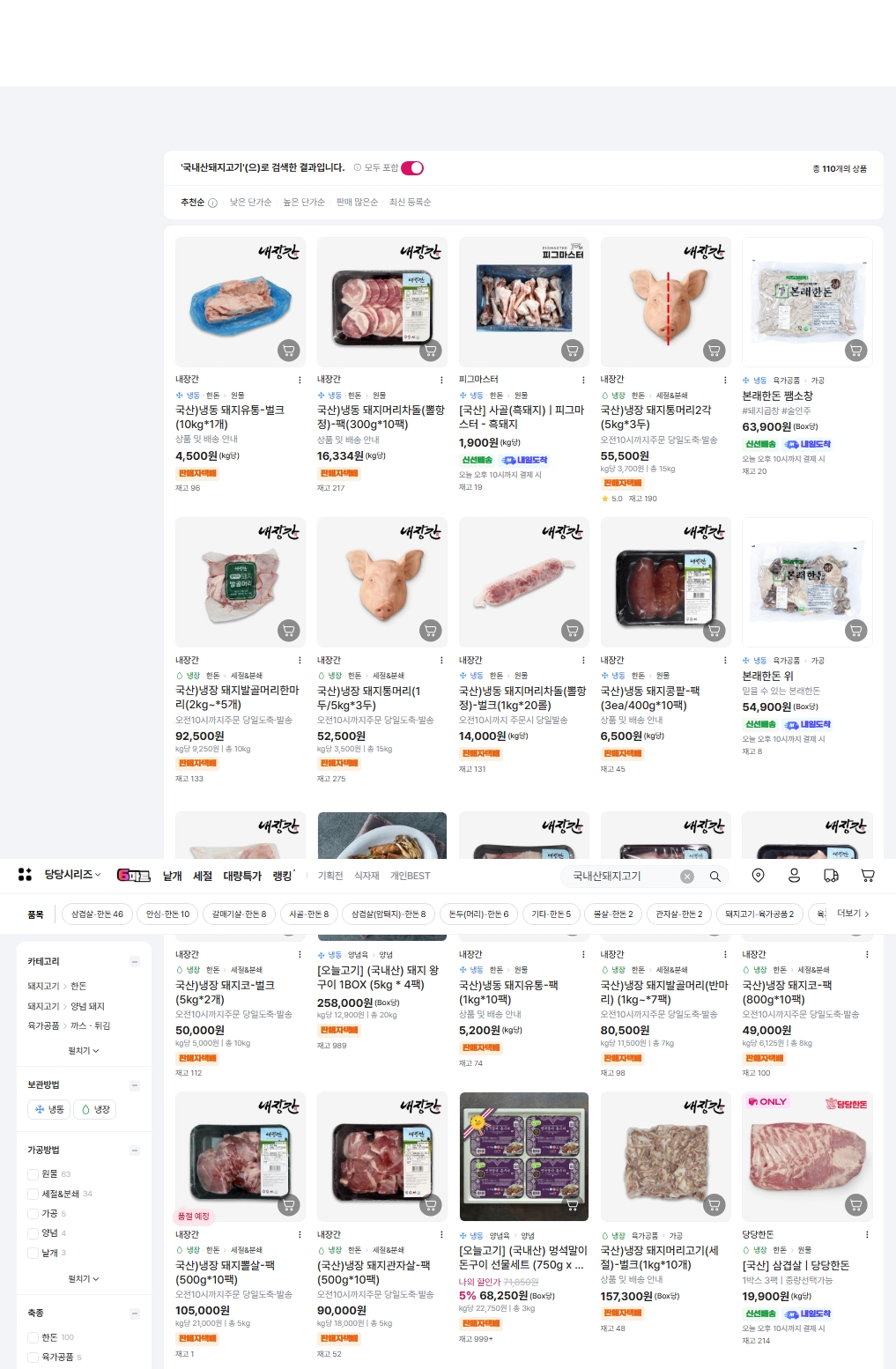
Figure 5.Online distribution examples of domestic pig heads, deboned heads, and specific parts.
However, this should not be interpreted as meaning that "deboning a whole head increases its value by 2.6 times." The weight of the product itself decreases because bones and unused tissues are removed during the deboning process. Deboning and trimming require labor costs, and as you move toward more specific cuts, additional costs for sorting, packaging, and storage are incurred.
Differences in selling prices and actual added value are entirely different matters. Nevertheless, one fact is clear: the same raw material—pig's head—is traded as products at completely different price points depending on the level of processing and trimming.
Product segmentation is also observed in the market for imported pig heads.
Currently, imported pig heads weighing approximately 5.2 kg are being sold at online retailers for 24,900 won per head. Based on the listed price, this is about 4,790 won per kg. Imported deboned pig heads, known as ‘masks,’ are being sold for 49,000 won for a 10 kg commercial product, which is 4,900 won per kg.
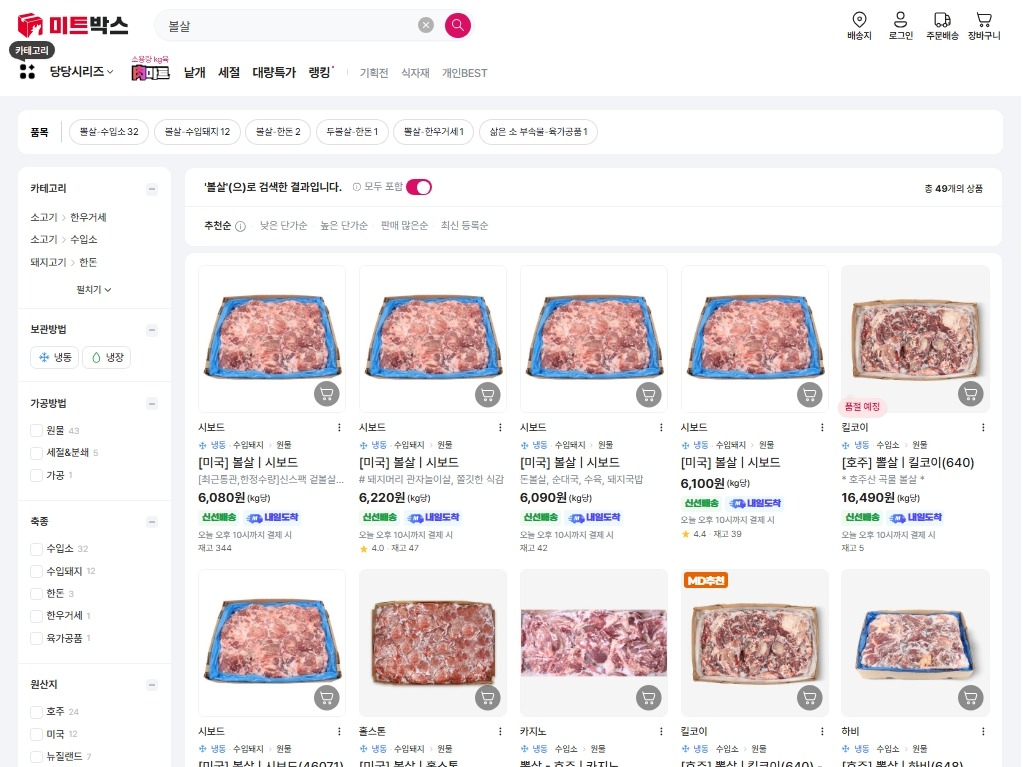
In the B2B market, U.S. pork cheek is also sold as a separate product. A recent search on Meatbox confirms instances where U.S. pork cheek is priced in the 6,000 won range per kg.
While pig heads are counted as a separate item in quarantine statistics, specific parts derived from the head, such as U.S. cheek meat, are also being distributed as separate imported products in the domestic B2B market.
The price list is already shifting from ‘one head’ to ‘parts’.
Pig heads have long been perceived as a byproduct used in dishes like gukbap and pyeonyuk. In fact, even in slaughterhouses and distribution centers, the practice of bundling the head and internal organs together and trading them as a single byproduct unit still exists.
However, a look at the current product market reveals other trends simultaneously. Whole heads are being replaced by deboned heads, which are then further divided into individual products with names such as brisket, neck meat, and cheek meat. And new prices are attached at each stage.

Can we say that the value has increased just because the price has gone up?
Prices for heads and offal have risen significantly since 2021. Imports of pig heads have also increased significantly. In the market, there are also deboned and cut-out products that command a higher price per kilogram than whole heads.
Then, can we say that the value of pork head meat is actually increasing? It is still too early to answer. This is because a high price is different from high profitability.
It is necessary to verify how much actual marketable meat is obtained when butchering a whole head, how much manpower and time are required to separate each part, and how much remains unsold. Research production figures also differ from actual sales yields.
Ultimately, the commercial value of a pig's head can only be determined by calculating the yield and costs together, rather than the price tag.

- #수입육
- #축산물
- #인터뷰
- #유통
- #기술
Related Content
DEEP DIVE
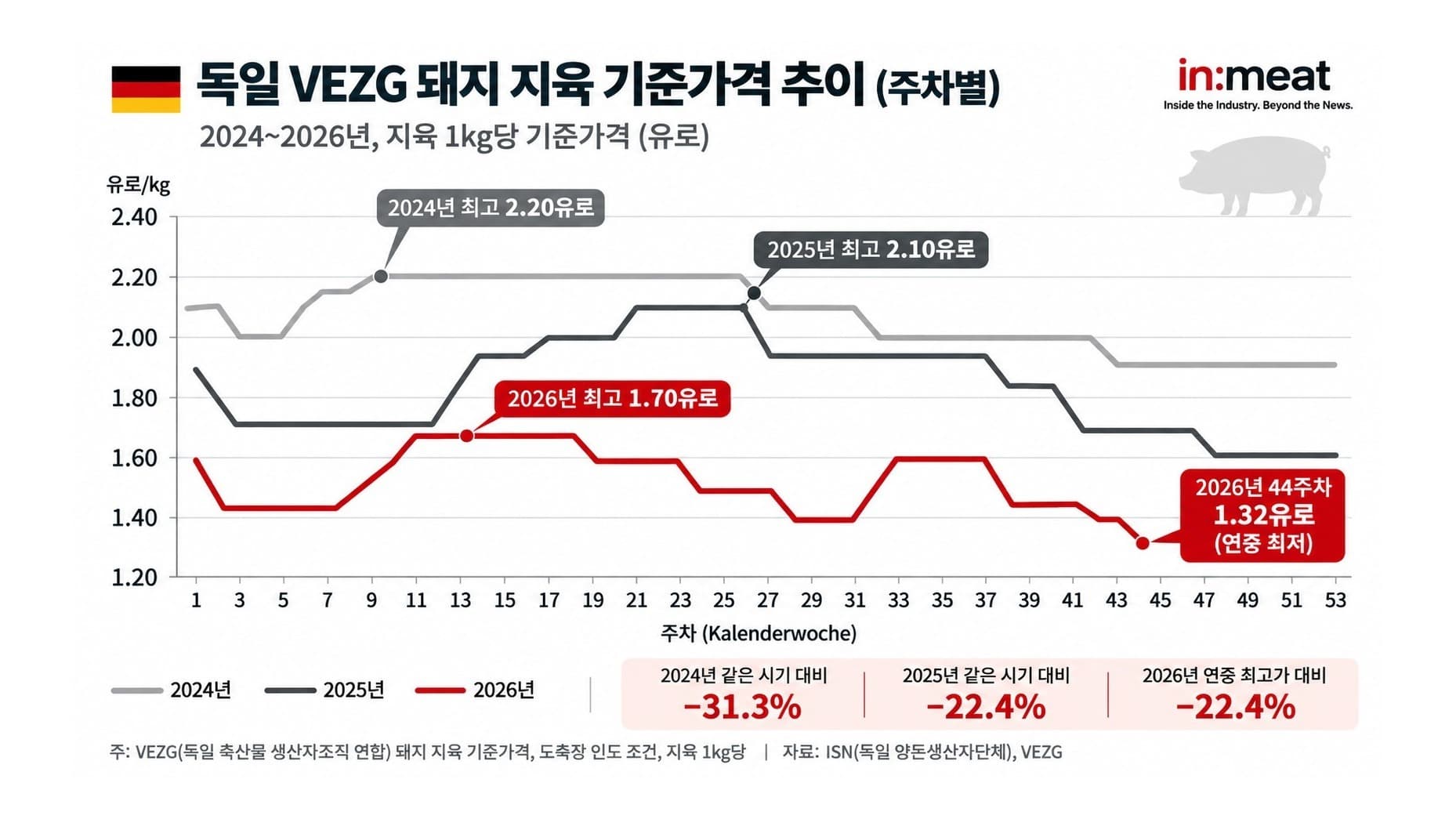
German Pig Prices 'Plunge'... 70 Euro Loss on Every Pig Sold
The management crisis for pig farms is deepening as the standard price of pork carcasses in Germany has fallen to 1.32 euros per kilogram. Producer organizations estimated that, taking into account total production costs, a loss of about 70 euros per pig is incurred.
2026.10.31
DEEP DIVE
The Hanwoo meat processing business driven into a struggle for survival—is there no way out?
The Hanwoo beef processing industry stands at a crossroads of survival. The burden of maintaining existing production facilities and personnel is increasing as slaughter volumes have followed a decline in the number of cattle raised. On top of this, industry insiders explain that the business environment for processing companies is deteriorating due to a confluence of factors, including rising raw meat prices, intense competition in the market for specific cuts, and market expansion moves by major players.
2026.10.26
DEEP DIVE
“We must buy it to survive” … Restaurant industry wages ‘raw material procurement war’ amid U.S. short rib shortage
The atmosphere surrounding U.S. beef short ribs in the domestic meat market is becoming increasingly volatile. Companies that had been delaying purchases due to rising import prices are now scrambling to secure raw materials, even if it means accepting the high costs. For restaurant businesses that sell ribs as their main menu item, the ability to continuously secure the necessary supply has emerged as a greater concern than the cost itself.
2026.10.21