
terrestrial broadcast
Dollars piling up in Korea… Will the exchange rate head below 1,300 won next year?
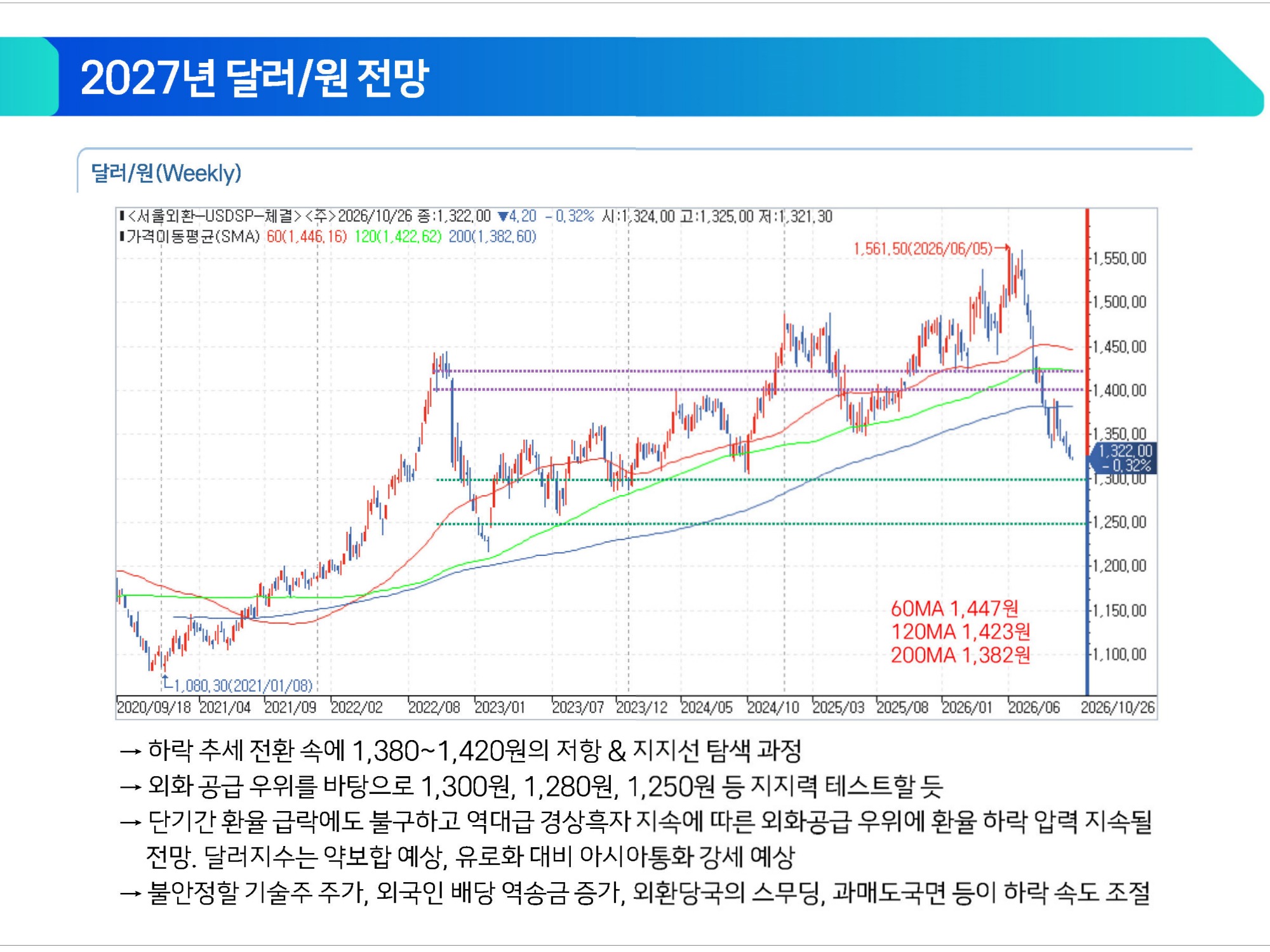
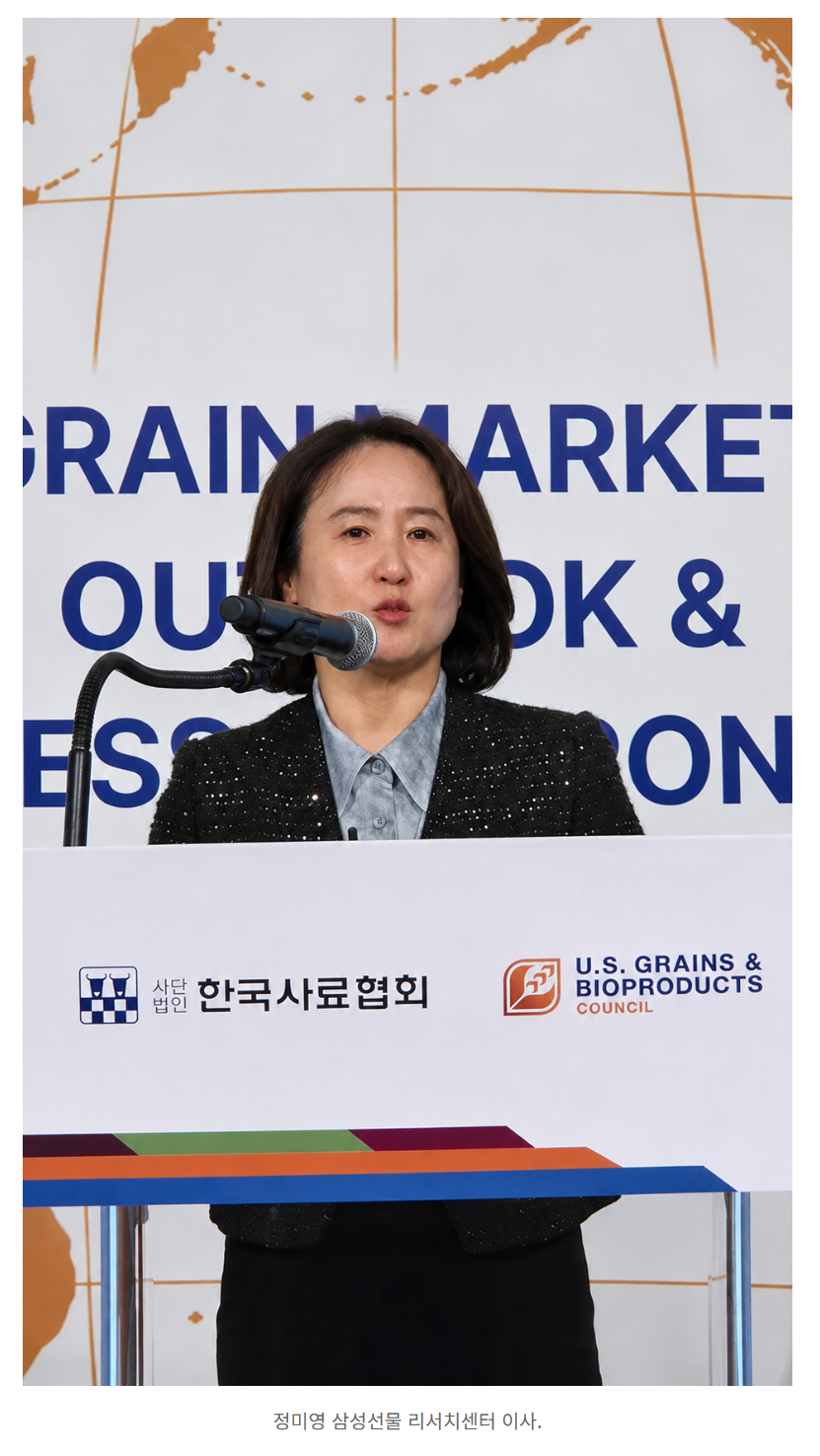
Jung Mi-young, Director at Samsung Futures, “Test of Support Levels at 1,300, 1,280, and 1,250 Won Expected”
November 3, 2026 · Seminar on the 2027 International Grain Market Outlook and Business Environment
Organized by: Korea Feed Association (KFA) · U.S. Grain Bio-products Council (USGBC)
Date: November 3, 2026 (Tue) 08:50–15:00 · Venue: Grand Ballroom, 3rd Floor, Four Seasons Hotel Seoul
"We expect that next year, driven by a large current account surplus, downward pressure on the exchange rate will prevail, and the rate will likely touch support levels such as 1,300 won, 1,280 won, and 1,250 won while monitoring external variables and other factors."
If the power to earn dollars is stronger than the demand to buy them, how low will the exchange rate fall? For Jung Mi-young, Director of the Research Center at Samsung Futures, who looks ahead to next year's won-dollar exchange rate, the starting point is the volume of dollars flowing into Korea.
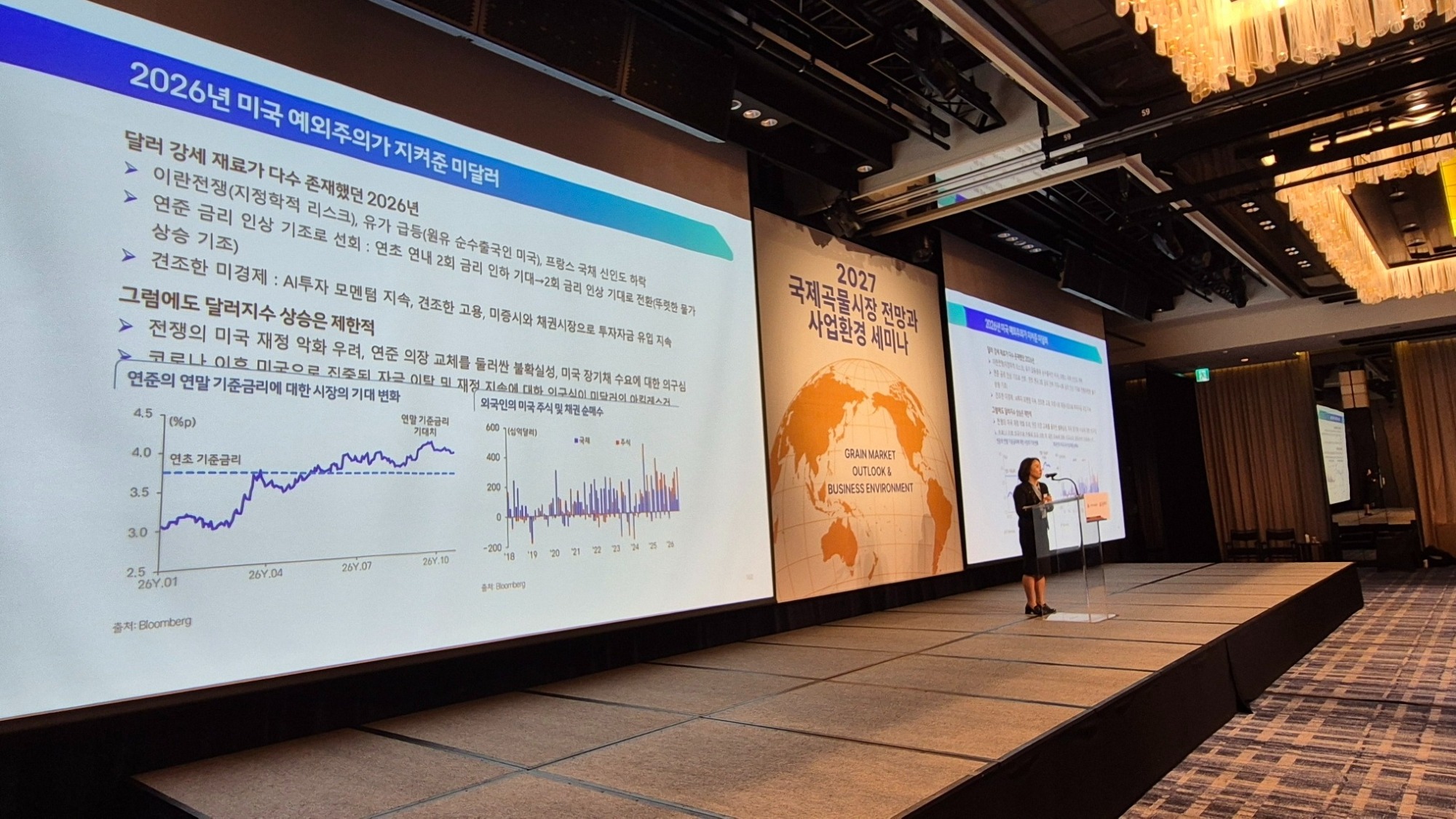
Director Jeong predicted that downward pressure on the exchange rate would prevail next year, based on semiconductor exports and a large current account surplus, at the ‘2027 International Grain Market Outlook and Business Environment Seminar’ jointly hosted by the Korea Feed Association (KFA) and the U.S. Grain Bio-Products Council (USGBC) at the Grand Ballroom on the 3rd floor of the Four Seasons Hotel Seoul on November 3, 2026.
However, this does not mean that it will drop straight down to 1,250 won. The view is that when rebounding, it will confirm resistance around 1,380 to 1,420 won, and when falling, it may test support levels such as 1,300 won, 1,280 won, and 1,250 won in succession. The figures presented are distinct from annual average forecasts or target prices that specify a timeframe for reaching them.
The dollars generated by semiconductors move differently from stock prices.
A key point to note in this forecast is the answer to the question, "Will Korea's dollar revenue decrease if the enthusiasm for AI investment cools down?" Director Jeong predicted that the two trends would not necessarily coincide.
Financial markets reflect expectations for the future first. Technology stocks may waver if concerns grow that AI investment has increased too rapidly or that returns are insufficient relative to the investment. However, just because stock prices undergo a correction does not mean that semiconductor supply contracts already signed will immediately disappear.
Director Jeong predicted that long-term contracts secured by semiconductor companies would support exports and profits next year. He explained that actual export proceeds could flow in even while expectations for AI investment fluctuate.
This implies that a situation is possible where instability spreads in the stock market while dollars accumulate in the foreign exchange market. The core of the announcement, the ‘mismatch between supply and demand and momentum,’ stems from this. Director Jeong predicted that this difference would continue to sustain Korea’s dollar supply dominance next year.
The reason the exchange rate is rising despite strong exports
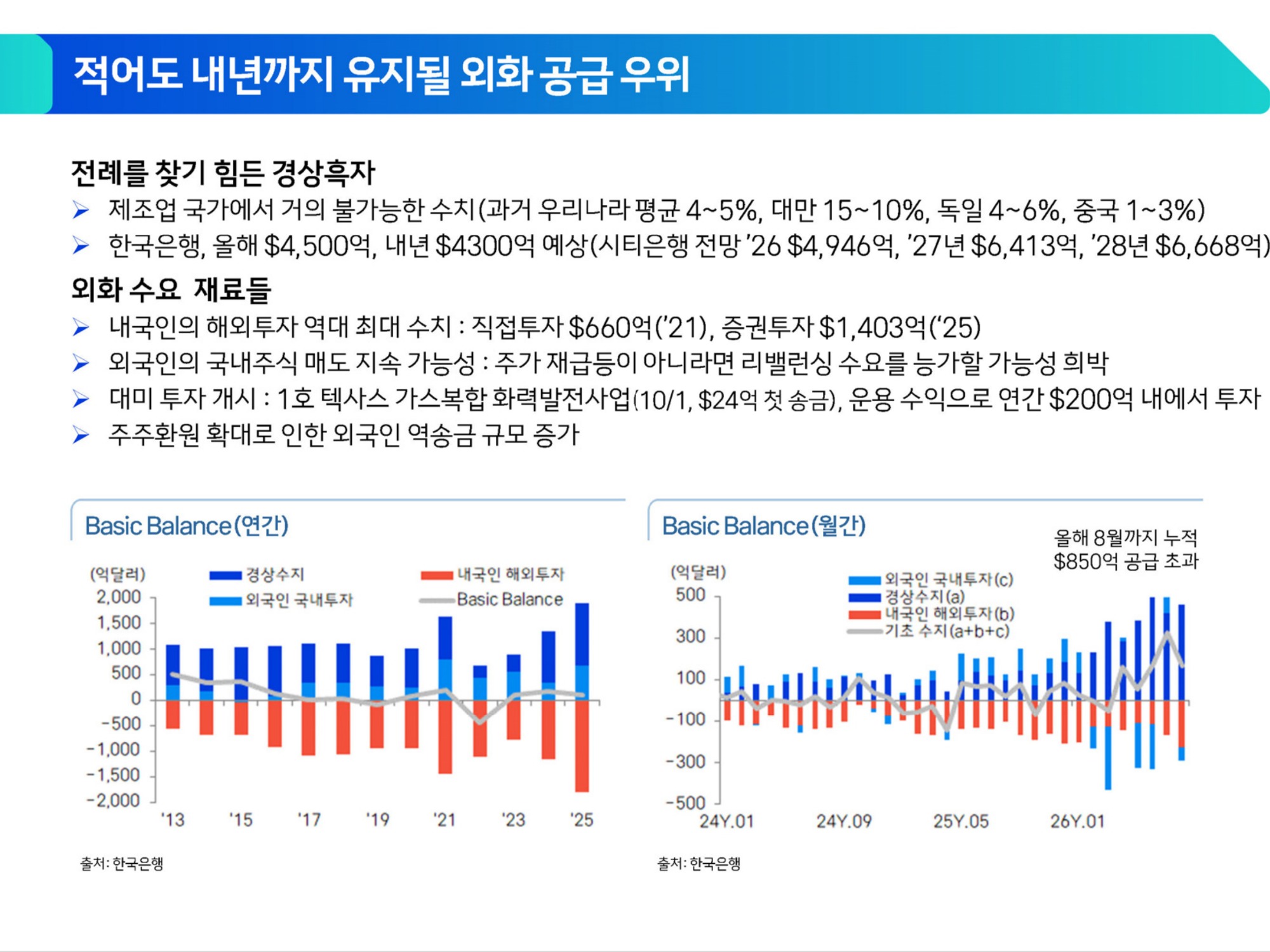
Then, should the exchange rate continue to fall if the current account surplus is large? Director Jeong explains that the actual foreign exchange market does not move that simply.
While dollars flow in through exports, demand for dollars arises when foreign investors sell domestic stocks and take funds overseas. This can occur even after stock prices have risen significantly. This is because if the value of Korean stocks increases and they account for a larger portion of total investment assets, foreign investors may sell a portion to meet their predetermined asset allocation ratios.
Currency hedging transactions also have an impact. If the value of held Korean stocks changes, the size of the hedge set to prepare for exchange rate fluctuations must also be adjusted. In this process, foreign exchange supply and demand arise that are difficult to identify through spot stock trading alone.
It is also important when export companies sell dollars. If they expect the exchange rate to rise further, the incentive to hold dollars increases. Conversely, if a downward outlook spreads, they may rush to sell.
This means that in addition to how much dollar is earned, one must look at who is releasing it into the market and when. Director Jeong explained that when supply and demand and sentiment turn in the same direction, the concentration of dollar supply could accelerate the pace of the exchange rate decline. He predicted that subsequently, this concentration effect would diminish, causing the downward trend to become much more gradual.
After export dollars come in, dividend dollars go out.
The increase in profits by semiconductor companies serves as the basis for the strength of the won and is also a factor that creates demand for the dollar with a time lag. This is due to dividends.
When a company converts dollars earned from exports into Korean won to pay dividends, foreign shareholders can convert the received won back into dollars and remit the funds overseas. This means that the impact on the foreign exchange market differs depending on whether export proceeds are coming in or going out as dividends.
Director Jeong emphasized that April, May, August, and November should be closely monitored in the foreign exchange market next year. He explained that demand for buying dollars could temporarily increase in April, when annual dividends are concentrated, and during the period when quarterly dividends are paid.
Even if corporate profits increase, the inflow of export proceeds and dividend payments do not occur simultaneously. This means that even if the annual supply of dollars is abundant, there is room for the exchange rate to rebound as demand surges during specific periods.
Corporate overseas investment should be viewed in the same context. If earned dollars are used for constructing overseas factories or for mergers and acquisitions, the volume converted into won domestically decreases. If the investment requires purchasing additional dollars, the demand for foreign exchange may increase further.
Will the dollar rise if U.S. interest rates rise?
Just as important as the dollars flowing into Korea is the direction of the dollar itself. Director Jeong predicted that the U.S. dollar will show a slight downward trend next year.
The key variables are the sustainability of AI investment and the fiscal burden on the United States. Analysts suggest that if demands grow to verify whether returns commensurate with massive investments can be generated, the expectations that have underpinned the relative strength of the U.S. economy could be shaken.
He explained that the way U.S. Treasury yields are interpreted must also change. He pointed out that the impact on the dollar is not the same when rates rise due to an economic boom as when they rise due to fiscal burdens or concerns about the supply and demand of government bonds. This means it is difficult to immediately translate a rise in interest rates into a stronger dollar.
However, they did not conclude that the dollar would weaken significantly. This is because there are not enough markets to absorb large-scale investment funds to replace the U.S., and Europe and China are also burdened by political and fiscal instability and slowing growth, respectively.
1,250 won is a reference point rather than the destination
The most eye-catching figure in the forecast is 1,250 won. However, Director Jeong attached a condition to this level.
The explanation is that if the won-dollar exchange rate is calculated backwards assuming the won's real effective exchange rate returns to its long-term average level, it comes out to around 1,250 won. This estimate of potential for a decline is based on the relative value of the won, which reflects differences in exchange rates and prices with various trading partners.
The market does not necessarily return to its long-term average. Director Jeong also made this point clear. Therefore, 1,250 won is not a price that will definitely be reached next year, but rather a reference point to consider when assessing a downward trend.
The response of foreign exchange authorities could also influence the actual trajectory. Director Jeong noted that even if a strong won has the effect of lowering the burden of import prices, there is a possibility that authorities will intervene to moderate the pace of a sharp short-term decline in the exchange rate.
For the imported meat and feed industries, which settle payments in dollars, a decline in the exchange rate is a factor that can alleviate the burden of purchasing in won terms. However, actual costs vary depending on overseas supply prices, the timing of payment, and whether currency hedging is employed. Therefore, a forecast of a falling exchange rate does not immediately mean a reduction in costs or improved profitability for all companies.
What needs to be confirmed in the market next year is not limited to how much dollar Korea earns. It is important to see when export companies sell those dollars, when foreigners take dividends, and how much companies invest overseas. The path toward falling below 1,300 won is also expected to be determined by the interplay between the direction in which dollars accumulate and the speed at which they are released into the market.
- #축산물
- #정책
Related Content
terrestrial broadcast
[Parliamentary Audit] 6 Cases of Mad Cow Disease and Controversy Over Notification Delays… Emerging as Key Issues in Brazilian Beef Import Negotiations
2026.10.7
terrestrial broadcast
Parliamentary audit of the Ministry of Agriculture, Food and Rural Affairs begins on the 7th… Audits of the Korea Animal Production and Health Agency, Animal Disease Control and Prevention Agency, and Livestock Environmental Management Agency on the first day
The 2026 parliamentary audit of the National Assembly Agriculture, Food, Rural Affairs, and Fisheries Committee will begin in earnest on the 7th at 10 a.m., starting with the Ministry of Agriculture, Food and Rural Affairs. The overall parliamentary audit began on the 6th, and the first audit schedule for the agriculture and livestock sectors is the 7th.
2026.10.5
terrestrial broadcast
[National Assembly Audit] “KALP receives fees, but slaughterhouses bear the costs”… Rep. Moon Dae-rim urges system improvement during audit
The burden of electricity costs for slaughterhouses and the costs of cutting work required for grading cattle carcasses were raised as tasks for institutional improvement during the 2026 parliamentary audit. While the Korea Animal Products Quality Evaluation Institute stated that it collected 11.8 billion won in grading fees last year, it was pointed out that the slaughterhouses are actually bearing the labor and costs required for the cutting work.
2026.10.5