
SPECIAL FOCUS
“Agricultural Production Declines by 710 Billion Won Annually”… Hanwoo and Hanpork Industries Rally in Gwanghwamun on the 15th
75 Agriculture, Forestry, Livestock, and Fisheries Organizations Hold National Farmers and Fishermen's Rally to Block CPTPP Membership
The agriculture, forestry, and fisheries industries, opposing the government's review of joining the Comprehensive and Progressive Trans-Pacific Partnership (CPTPP), will hold a large-scale joint rally in Gwanghwamun, Seoul, on the 15th. Concerns are also growing within the domestic livestock industry, including Hanwoo and Hanpork, as the government's recently released economic impact analysis projects an average annual decrease of 710 billion won in agricultural production.
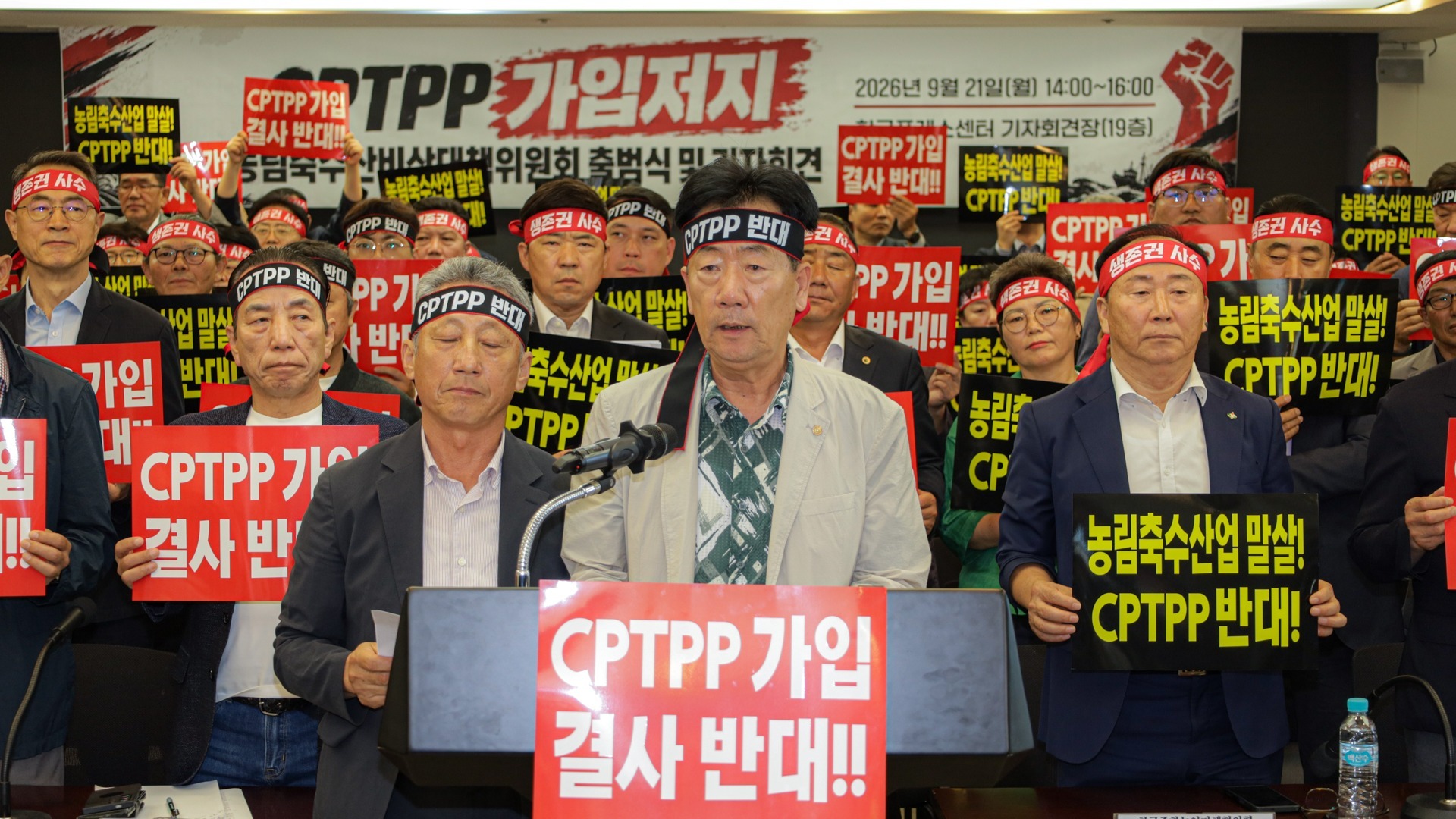
75 Agriculture, Forestry, Livestock, and Fisheries Organizations to Hold Joint Action in Gwanghwamun on the 15th
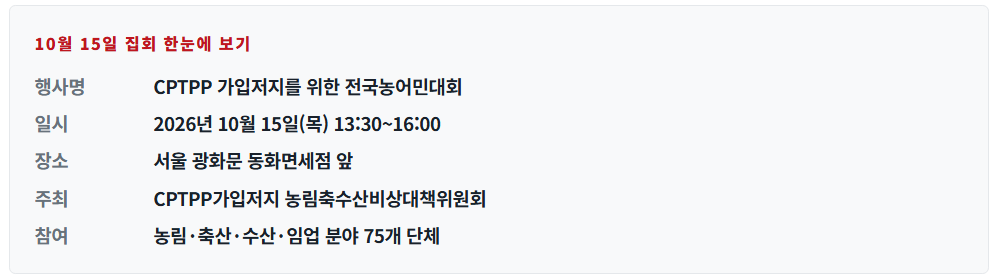
The Emergency Countermeasures Committee of Agriculture, Forestry, Livestock, and Fisheries to Block CPTPP Membership plans to hold the ‘National Farmers and Fishermen’s Rally to Block CPTPP Membership’ in front of the Donghwa Duty Free Shop in Gwanghwamun, Seoul, from 1:30 PM to 4:00 PM on October 15.
The emergency committee includes 75 organizations from the agriculture, livestock, fisheries, and forestry sectors, such as the Korea Agricultural and Livestock Federation, the Council of Livestock-Related Organizations, and the Korean Peasants League. In the livestock sector, the Korean Hanwoo Association, the Korea Pork Producers Association, and the Korea Dairy and Beef Cattle Association are participating.
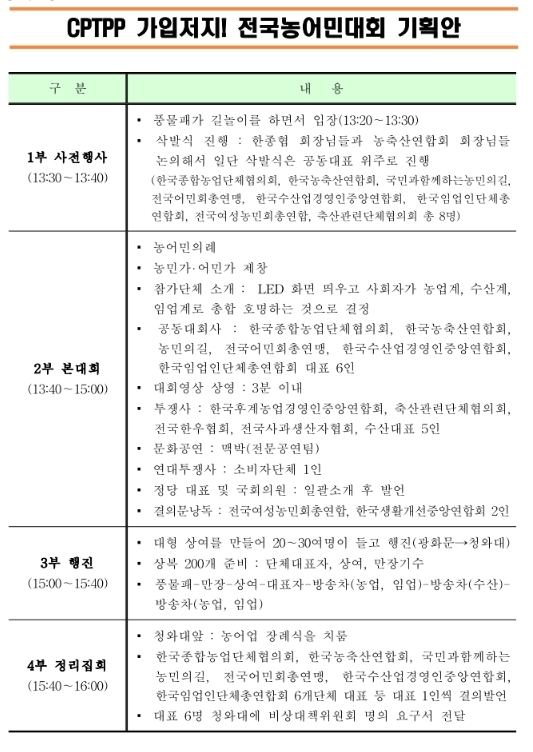
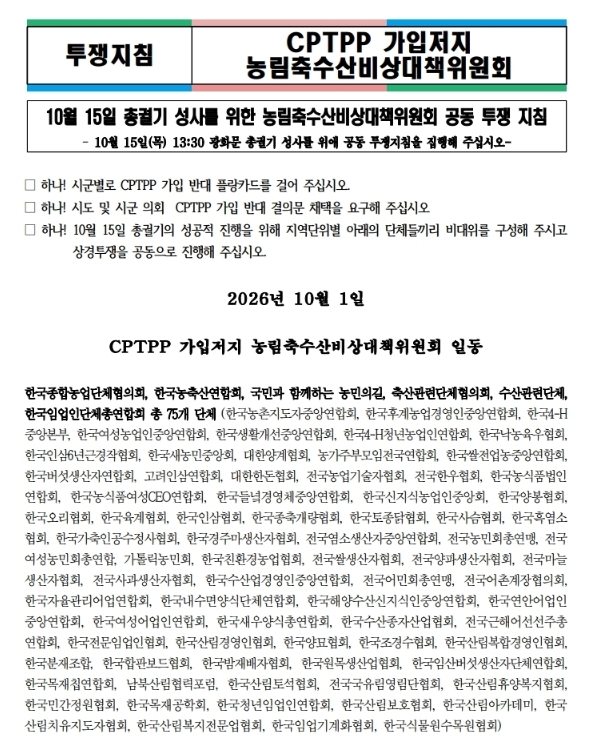
The organizers plan to urge a halt to discussions on joining the CPTPP and convey their demands to the government through speeches by industry representatives and solidarity groups, as well as marches, during the rally. The agriculture, forestry, livestock, and fisheries sectors maintain that a high level of additional market opening could burden the domestic production base and food security.
Government Impact Analysis: Annual Decrease of 852.3 Billion Won in Agriculture, Forestry, and Fisheries Production
The economic impact analysis released by the government on September 28, ahead of the rally, became a major background to this conflict. According to an analysis conducted by the Ministry of Trade, Industry and Energy, the Ministry of Agriculture, Food and Rural Affairs, the Ministry of Oceans and Fisheries, the Ministry of SMEs and Startups, and the Korea Forest Service in collaboration with relevant research institutions, agricultural production is projected to decrease by an average of 710 billion won annually over the 15 years following the entry into force of the CPTPP.
The Korea Rural Economic Institute estimated that forestry production would also decrease by an average of 60.6 billion won per year, while the Korea Maritime Institute projected an average annual decrease of 81.7 billion won in fisheries production. Combined, the projected annual decrease in production for agriculture, forestry, and fisheries amounts to 852.3 billion won.
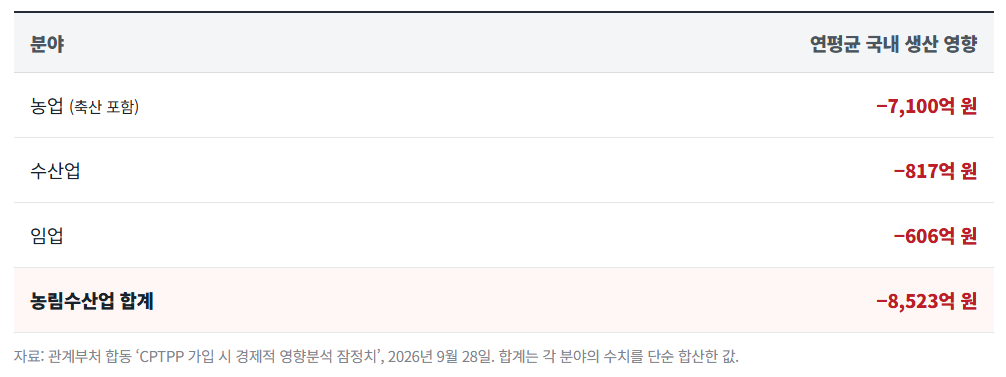
Conversely, in the manufacturing sector, it was analyzed that an annual production ripple effect of 6.3 trillion to 6.7 trillion won would occur over the 15 years following the agreement's entry into force. A macroeconomic analysis by the Korea Institute for International Economic Policy estimated that Korea's real gross domestic product (GDP) 10 years after the agreement comes into effect would be 0.38 percentage points higher than in a non-joining scenario.
Since manufacturing figures include production ripple effects from forward and backward related industries, it is difficult to calculate profit and loss by simply comparing them with the decrease in production in agriculture, forestry, and fisheries. Additionally, the 0.38 percentage point in the GDP forecast does not represent an additional annual growth rate, but rather the difference between the two scenarios 10 years after the implementation.
How much is the damage to Hanwoo and Hanpork? ... It is missing from government released data.
What the livestock industry is focusing on is how much of the livestock sector, including Hanwoo, Han-don, and dairy farming, is included in the projected 710 billion won decrease in agricultural production. However, the press release issued by the government on September 28 did not separately present the projected decrease in production by item or the increase in imports by livestock type.

Twelve countries, including Japan, Australia, Canada, New Zealand, Mexico, Vietnam, and the United Kingdom, participate in the CPTPP. South Korea has already concluded free trade agreements (FTAs) with several member nations, including Australia, Canada, and New Zealand. However, as the bilateral FTA with Mexico has not yet entered into force, market access conditions for livestock products are considered a major point of interest in future accession negotiations.
The import conditions for beef and pork must be examined in conjunction with the existing FTA tariff reduction schedules and the conditions to be determined during the CPTPP accession process. It cannot be concluded that a specific country's beef and pork imports will immediately increase merely based on the review of accession.
In particular, since the CPTPP includes regulations regarding Sanitary and Phytosanitary Measures (SPS), relationships such as zoning and compartmentalization linked to livestock infectious diseases, as well as import sanitary conditions, are also subject to inspection. However, joining the CPTPP itself does not mean the automatic opening of prohibited import items or the blanket relaxation of quarantine standards.
“Discussion on membership suspended” vs. “Membership application undecided”
On September 21, the agriculture, forestry, and fisheries industries launched an emergency countermeasures committee with 75 participating organizations at the Korea Press Center in Seoul and have been demanding a halt to the review of joining the CPTPP. The rally on October 15 is intended to expand this opposition into a nationwide joint action.
The government explains that membership has not been finalized. In materials from a meeting with the service and intellectual property industries on October 8, the Ministry of Trade, Industry and Energy stated...Whether and when to apply for membership has not yet been decided., stated that it would fully consider opinions from various industries.
The government is reviewing the anticipated burden on agriculture, forestry, and fisheries alongside expected trade opportunities in manufacturing and service sectors, but the industry maintains that the protection of the domestic production base must take precedence.
Ultimately, triggered by the Gwanghwamun rally on the 15thHow transparently the government will explain the detailed basis for the forecast of declining agricultural production and the impact analysis by livestock typeAnd how to reflect concerns from the field in trade policy is expected to become a key issue.
- #축산물
Related Content
SPECIAL FOCUS
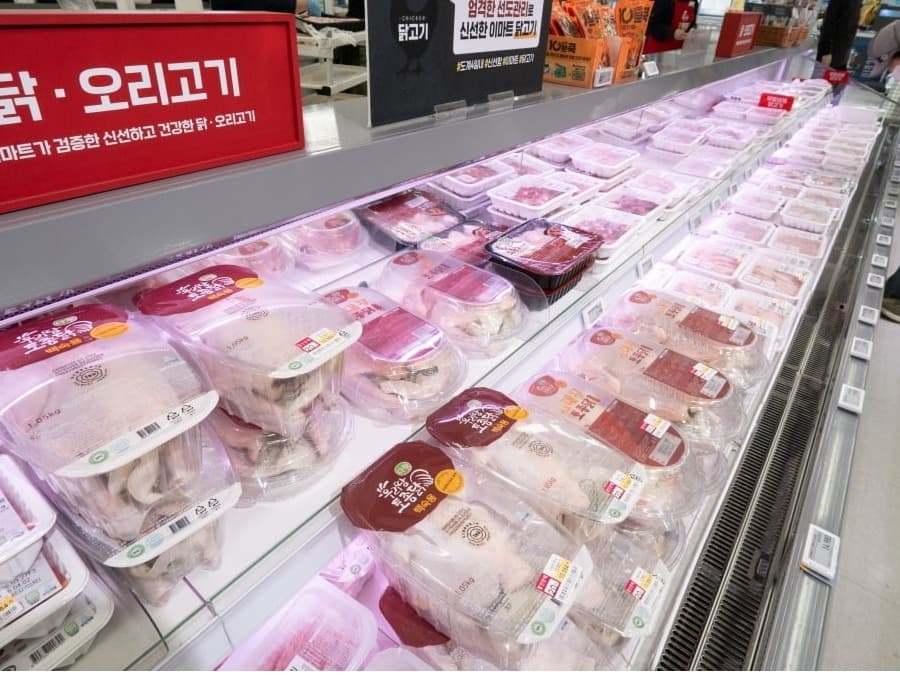
Chicken Supply Rises, But Cuts Are Short… Mixed Supply and Demand Battle Amidst November Price Drop
The broiler market in November is expected to face increasing downward price pressure due to the rise in slaughter volume. However, it is difficult to conclude that the overall supply and demand in the chicken market has become sufficient based solely on the increase in supply.
2026.11.6
SPECIAL FOCUS
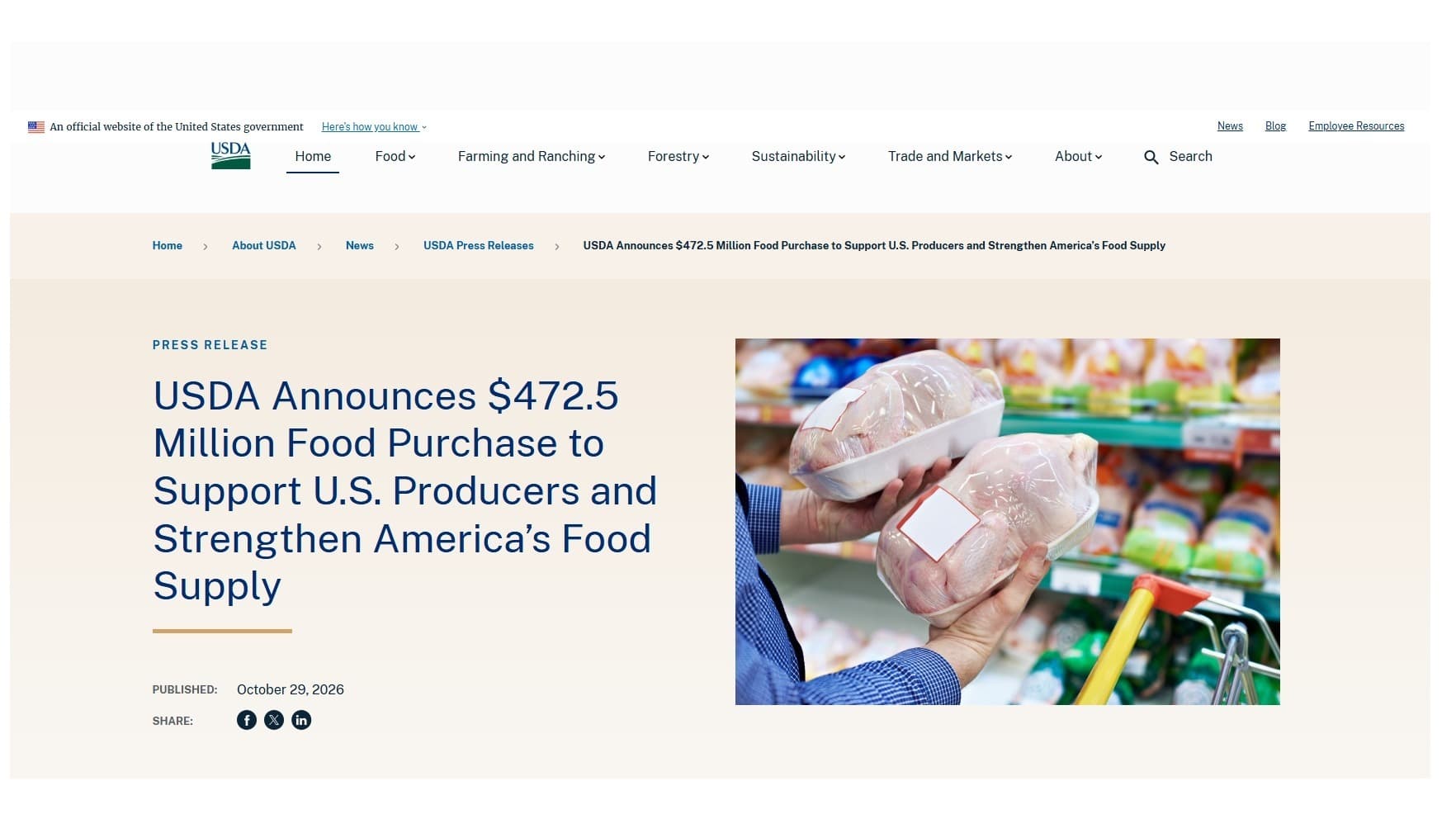
U.S. Government to Purchase $41 Million in Pork… Supporting Market Stabilization for Agricultural, Livestock, and Fisheries Products
The U.S. Department of Agriculture (USDA) announced a plan to purchase agricultural and fishery products worth a total of $472.5 million, including $41 million in pork and $20 million in chicken.
2026.11.1
SPECIAL FOCUS
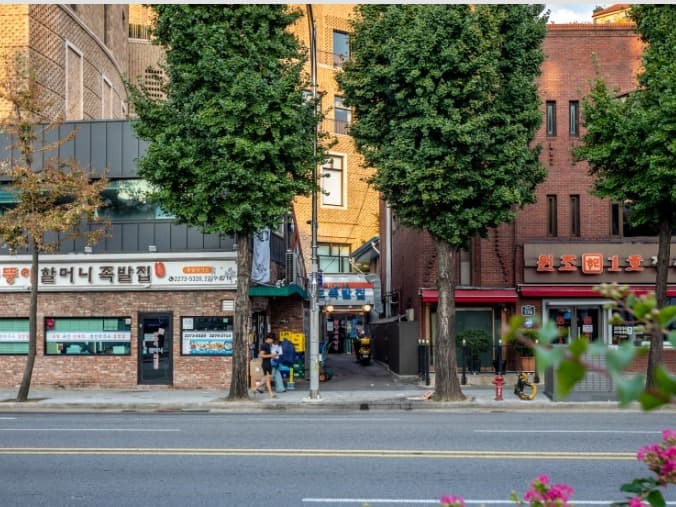
Pork trotters restaurants have changed, but the raw material market remains the same… What is the way out for domestic pork trotters?
The fact that domestic pig's trotters are not selling does not mean that consumption of pig's trotters has disappeared. The issue lies in how well the market supplying the raw materials has kept pace with the changes in how consumers select and order pig's trotters.
2026.10.29