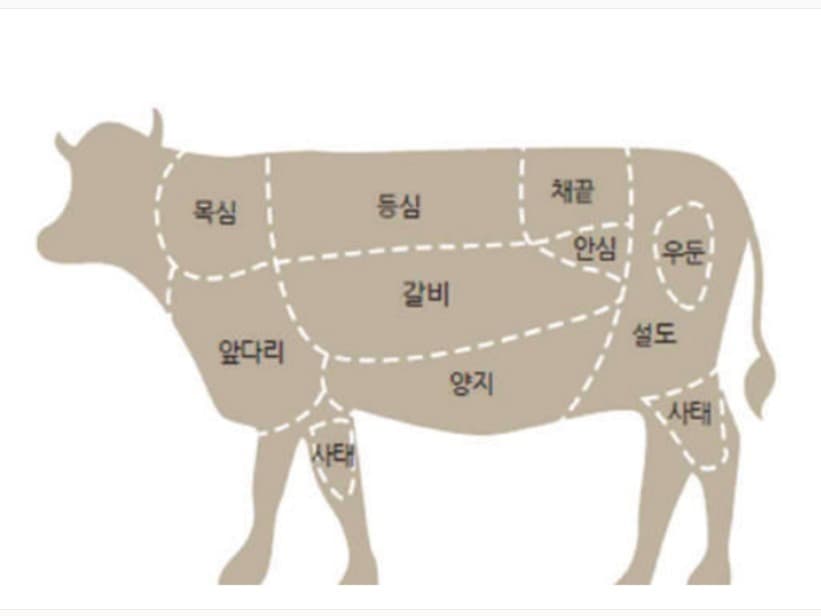
Understanding Meat Correctly / Basic Knowledge of Meat
MEAT ECONOMICS ② Pig | The Value of a Whole Pig The Economics of a Single Pig… From the Carcass to Pork Belly, Ribs, and Specialty Cuts
From grade to ribs, pork jowl, pork neck, and fat… Exploring the market value of a whole pig

When talking about a pig, the first cut that comes to mind is pork belly. However, the market value of a pig cannot be explained solely by pork belly.
Slaughtered pigs are graded while still in the carcass state and undergo a trimming process. They are separated into major cuts such as ribs, forelegs, and hindlegs, as well as special cuts like gabrisal and hangjeongsal, which yield only a few hundred grams per pig. The fat separated during the trimming process also becomes a raw material.
Ultimately, a pig is not just a piece of meat.A collection of various products with different values depending on production volume, characteristics of the cut, consumer preferences, and processing and cooking methods.all.
Pork also gets grades.
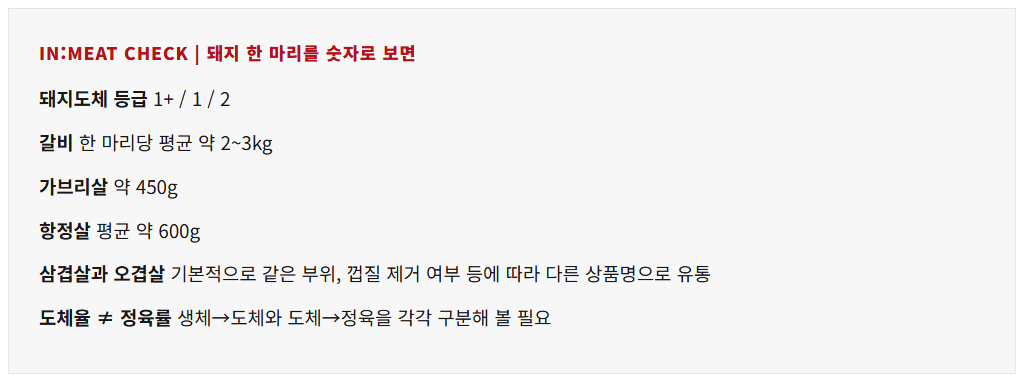
Domestic pork is also graded in the carcass state,Grades 1+, 1, and 2It is classified as such. However, there is a difference in that grade labeling is voluntary rather than mandatory for pork sold in the market.
Grading is divided into first and second stages. In the first stage, standards are determined based on carcass weight and back fat thickness, while in the second stage, the final grade is determined by examining appearance, meat quality, defects, etc.

You cannot explain a pig with 'yield' alone.
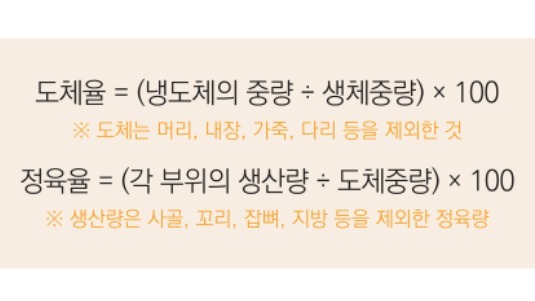
One of the terms frequently used in the pork industry is ‘yield.’ However, the raw data isDistinguishing between carcass yield and meat yieldHe explains that it is necessary to look into it.

Carcass yield refers to the proportion of the carcass—excluding inedible parts after slaughter—to the total weight of live livestock. Meat yield refers to the proportion of the carcass that is converted into actual meat for commercial sale.
What is the difference between pork belly and five-layered pork belly, both from the same pig?
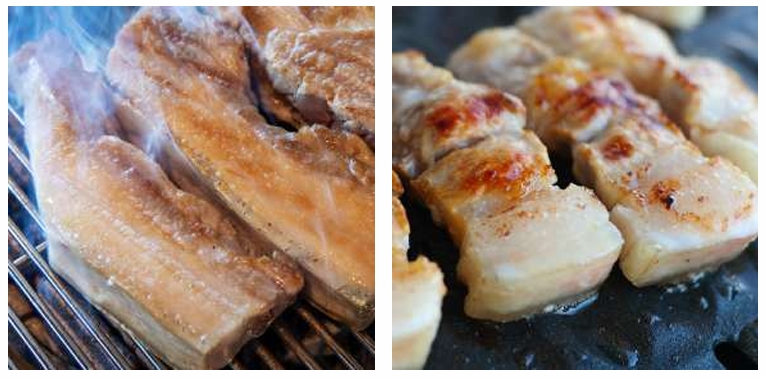
Although pork belly and five-layered pork belly are sometimes sold as completely different cuts, they are fundamentally the same part. The source material explains the difference between pork belly with the skin removed and pork belly with the skin still intact, which are distributed in the market under the name "five-layered pork belly."
In other words, even the same part of the raw materialProducts can be perceived as different depending on the standardization method, sales method, and the name given in the market.
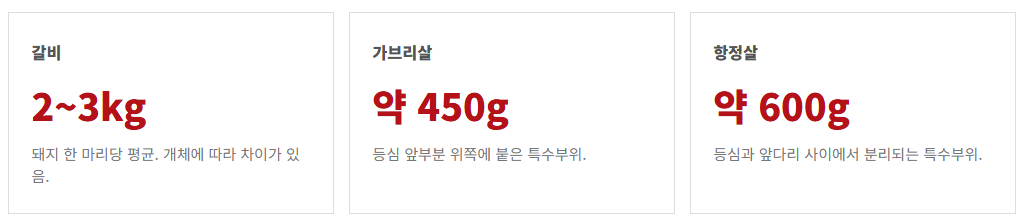
2~3kg ribs, 450g pork jowl, 600g pork neck
Not all parts are produced in equal quantities from a single animal. According to the source data, the ribs from one pig average about 2 to 3 kg, although there are individual differences. It is reported that about 450 g of gabrisal and about 600 g of hangjeongsal are produced.
We cannot increase production of only pork jowl and pork neck just because consumers are looking for them more.
This is because the amount produced from a single animal is limited.
Gabrisal, Galmaegisal, and Hangjeongsal: Why ‘Special Cuts’ Are Special
Gabrisal, also known as loin flap, is the part attached to the upper front portion of the loin that is separated and trimmed. The source data states that the amount produced from one pig is approximately 450g.
Pork jowl is introduced as a representative specialty cut along with pork shoulder and pork skirt. On average, about 600g is produced from one animal, and it is characterized by fat that is evenly distributed among the lean meat.
Pork diaphragm meat is the diaphragm muscle of a pig. Because of its name, it is easy to think that it is related to the bird ‘seagull,’ but it is actually a muscle that extends from the breastbone inside the rib cage to the lumbar spine.
These special cuts are not only about taste and textureThe fact that the absolute amount produced from one animal is smallThis influences the formation of market value.
Even wasted fat becomes a product again.
The economics of a pig does not end with the lean meat. The fat separated during trimming and processing is also reused for various purposes.
The raw material introduces a case where pork fat collected from a meat processing plant is classified into Grade A and Grade B and supplied. It explains that Grade A is mainly used for food, diet products, and fat products, while Grade B is used for industrial raw materials.
In other words, the value does not disappear just because it is separated during the formalization process.How much value can be recovered from a single animal depends not only on the sale of lean meat but also on the utilization of fat and by-products.
1kg of raw meat is not 1kg at the dining table.
The yield of meat changes again during the cooking stage. When heat is applied to the meat, moisture and fat escape, resulting in heat loss, which causes a decrease in weight.
In a specific study cited in the source material, cooking loss varied by cooking method, with grilling at 20.1%, boiling at 18.9%, pan-frying at 31.4%, and charcoal grilling at 40.2%. Since these values are from specific studies, they are not figures that apply uniformly to all pork.
However, from the perspective of the food service and catering industries, it has significant meaning.This is because buying 1kg of raw meat and 1kg of cooked meat provided to consumers are not the same concept.
Freezing and thawing also change product value
Buttered meat undergoes storage and distribution processes before reaching the consumer. The source material describes refrigeration and freezing as the primary storage methods and explains that refreezing thawed meat is not recommended due to the potential for quality degradation.
Ultimately, even if it receives a high grade and is trimmed into good cuts, storage and distribution management must be carried out together to maintain its value until the final consumption stage.
What is the blue stamp on the pig skin?
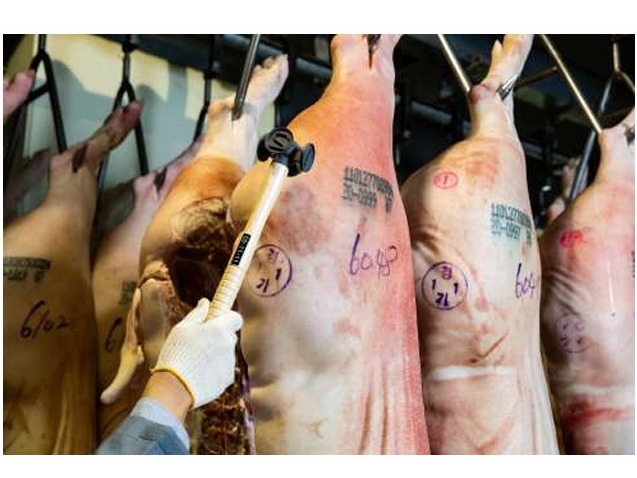
If you look at pig carcasses, you may see blue or red marks stamped on the skin. According to the source, these are markings used during the quality grading or inspection process, and they use food coloring.
The marks stamped on the carcass are not traces of contamination, but rather the process a pig undergoes until it is distributed as meat.Traces of the inspection and judgment processIt can be seen as such.
Ultimately, a pig is a ‘portfolio of cuts.’
In the pork market, the price of pork belly is often discussed as if it represents the entire market. However, if you actually look at a single pig, its structure is much more complex.
Slaughtered pigs are graded while still in the carcass state, trimmed, and divided into various cuts. Even the same pork belly can be recognized by different product names depending on how the skin is processed, and the quantity of ribs and special cuts obtained from a single pig is limited. The fat is also transformed into other products and raw materials.
In the pork industry, the price at which pork belly can be sold is not the only important factor. The economic viability of a pig is determined by how much value can be realized in the market from every part of the animal.
A single pig is not a single product, but a portfolio of various products with different production volumes and demands.


- #축산물
- #유통
- #품질관리
- #기술