
On-site coverage
Meat processing industry facing ‘inventory bomb’… Will pork prices remain strong until year-end?
Domestic meat inventory up 56.4%, imported 15.4%... Raw pork prices fail to reflect distribution realities
The simple sum of domestic and imported pork inventory, as compiled and estimated by the meat distribution industry, has exceeded 227,000 tons, increasing the management burden on the meat processing industry. Nevertheless, on-site observations suggest that wholesale pork prices do not fully reflect the slump in the meat market. Amidst this, some meat distribution officials are placing weight on the possibility that pork prices will not fall sharply from October to December but will maintain a strong, stable trend.
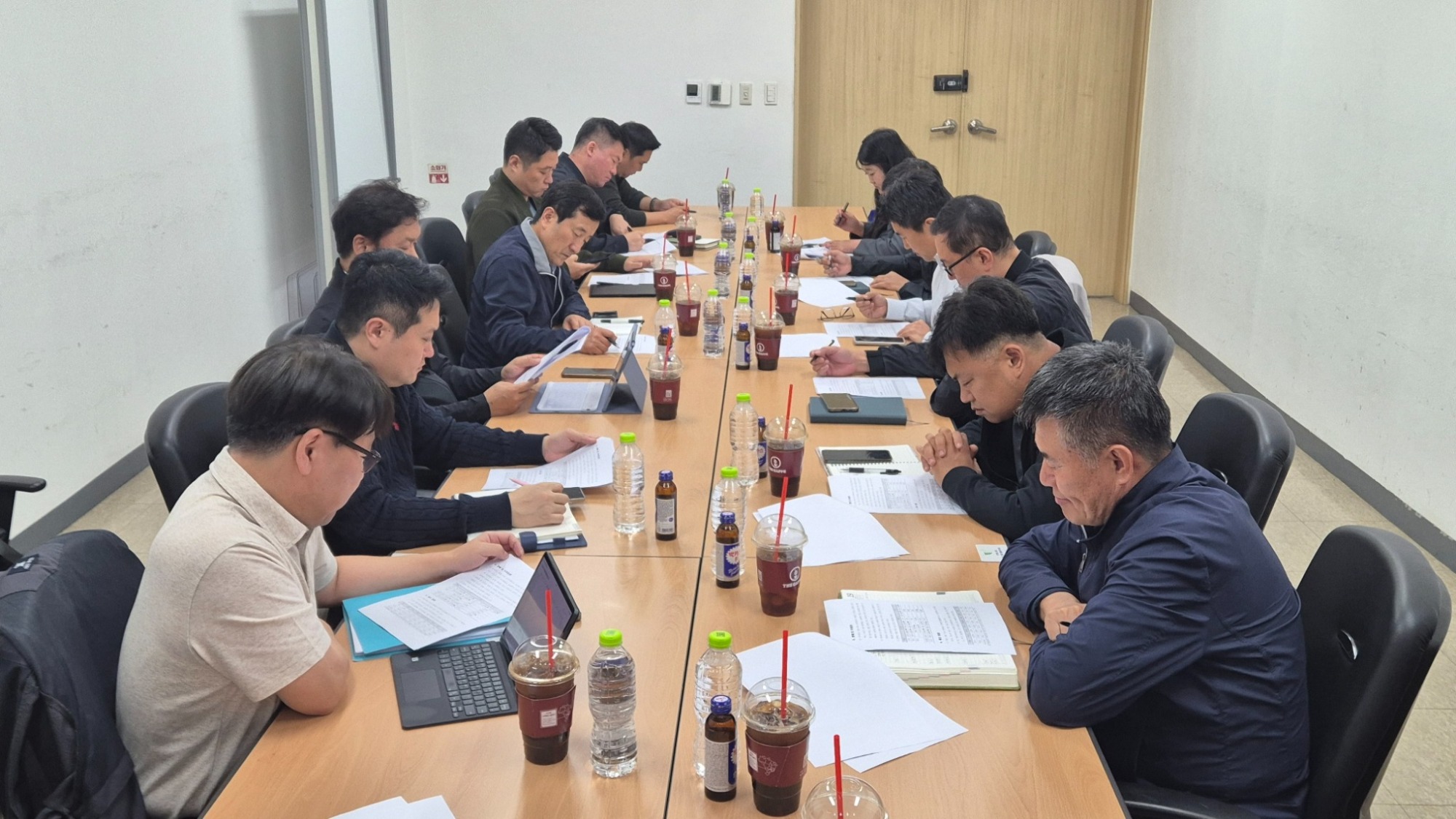
The Agricultural Observation Center of the Korea Rural Economic Institute predicted a decline in wholesale pork prices in October and November based on an increase in the number of slaughtered pigs. However, companies that actually purchase, slaughter, and process pigs are struggling amidst high raw material purchase prices, sluggish sales of cut meat, and accumulated inventory.The fact that the movement of live pork prices and the perceived economic conditions in the meat market are out of sync.This is the key to understanding this year-end market.
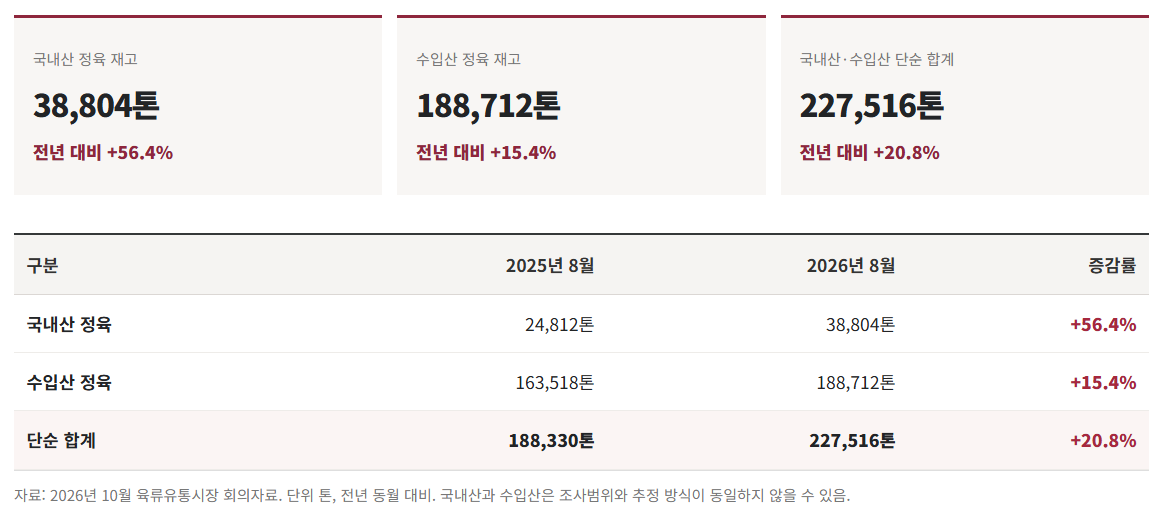
Inventory of domestic and imported meat reaches 227,516 tons… up 20.8% in one year
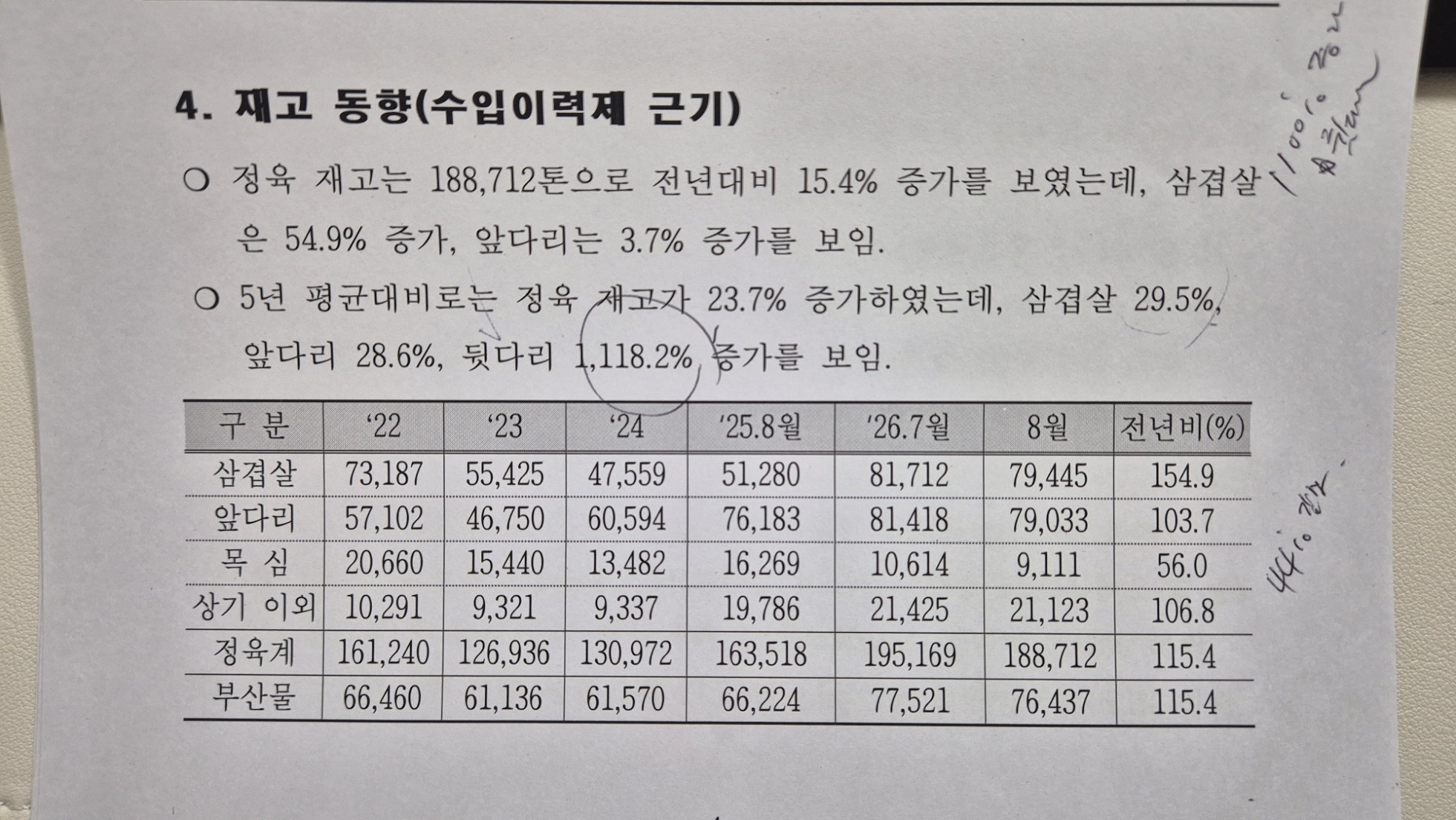
According to the August inventory data shared at the October Meat Distribution Market Meeting, the estimated inventory of domestic pork is38,804 tons...compared to 24,812 tons in the same month of the previous yearIt increased by 56.4%.The inventory of imported meat is from 163,518 tons188,712 tonsIt increased by 15.4%.
When the two figures are simply added together, inventory increased from 188,330 tons in August of last year to 227,516 tons in August of this year. The increase alone amounts to 39,186 tons. However, since the domestic figure represents a nationwide inventory estimate based on a survey of member companies and the imported figure represents the meat inventory tallied in the same survey, the total should be interpreted as a reference indicator obtained by adding the two survey values.
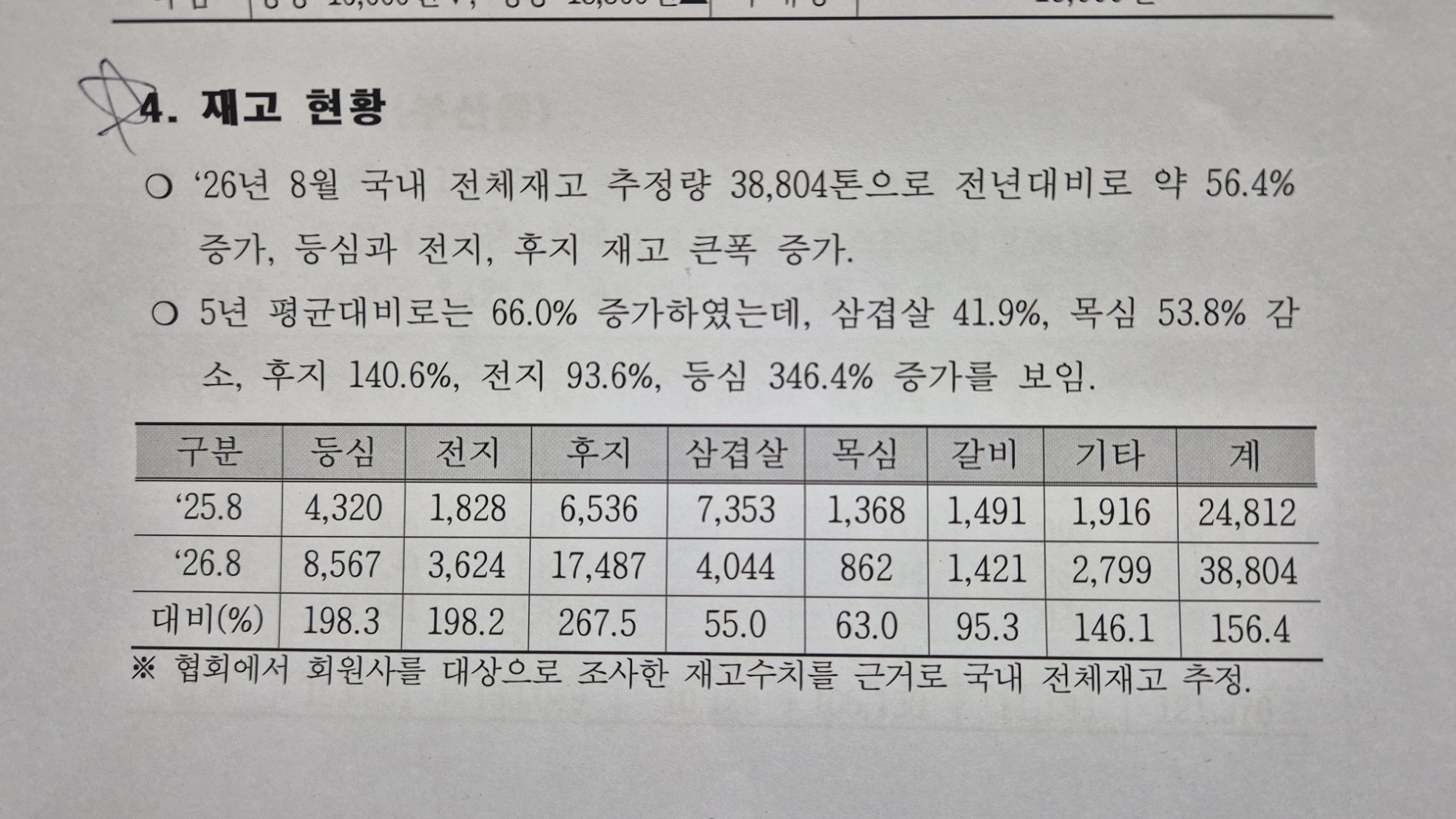
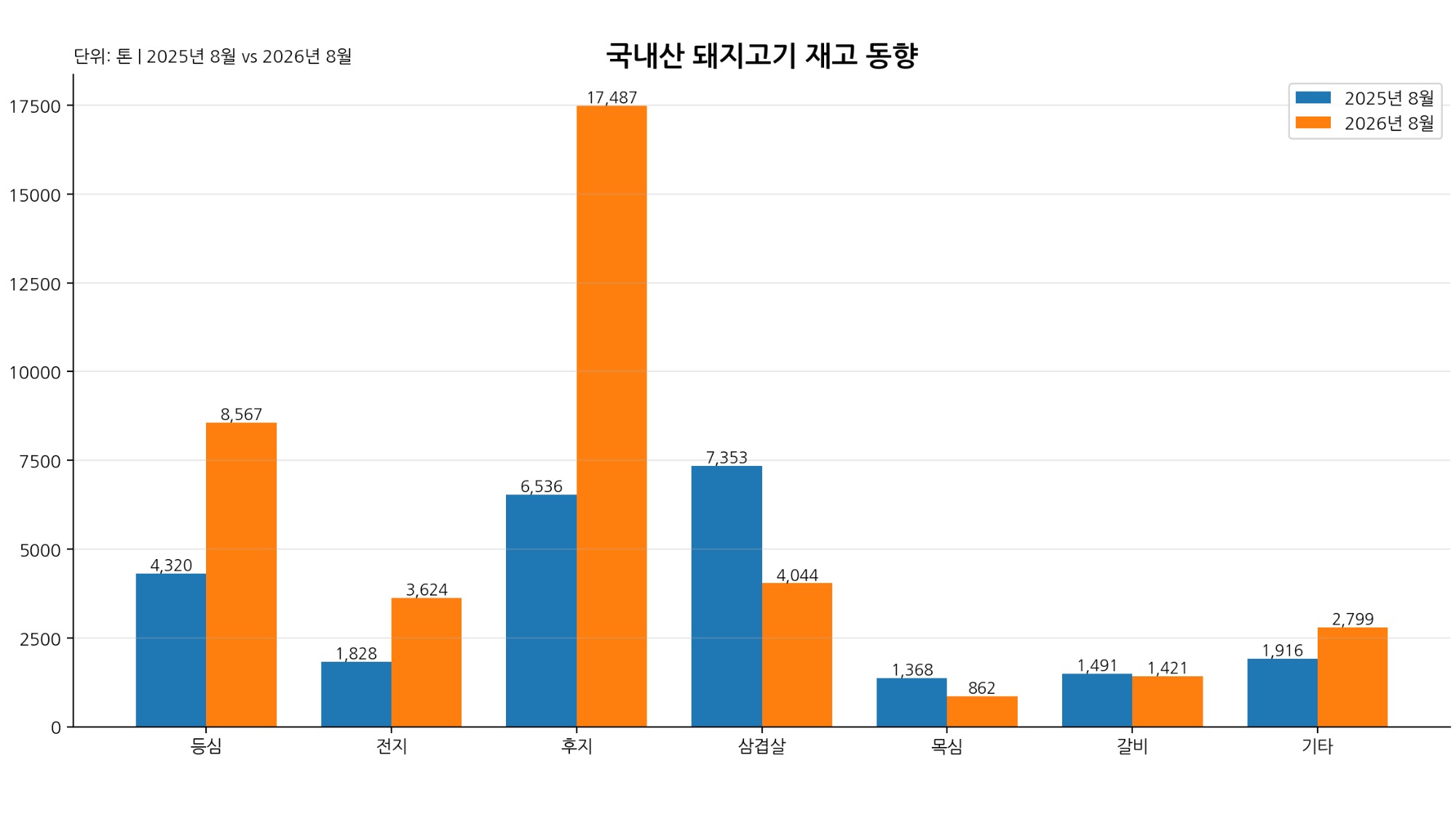
Hind leg up 167.5% · Loin up 98.3%… Inventory of domestic lean cuts surges
The most prominent feature of domestic meat inventory is the disparity by cut.Hind leg (hind leg) inventory increased by 167.5% from 6,536 tons to 17,487 tons....did. Loin increased by 98.3% from 4,320 tons to 8,567 tons, and foreleg (shoulder) increased by 98.2% from 1,828 tons to 3,624 tons.
On the other hand, pork belly decreased by 45.0% from 7,353 tons to 4,044 tons, and pork neck decreased by 37.0% from 1,368 tons to 862 tons. Rather than a situation where the entire domestic market is uniformly surplus, the structure is one where inventory accumulation is concentrated in cuts intended for processing.
Meeting participants noted, in particular, the weakening demand for raw materials such as loin and hind leg. Opinions from the field were raised that certain domestic cuts used for pork cutlets, institutional catering, and food processing are facing difficulties securing sales channels due to competition with relatively cheaper imports. This assessment is based on the transaction experiences of individual companies, and further verification is required regarding the scale of import substitution.
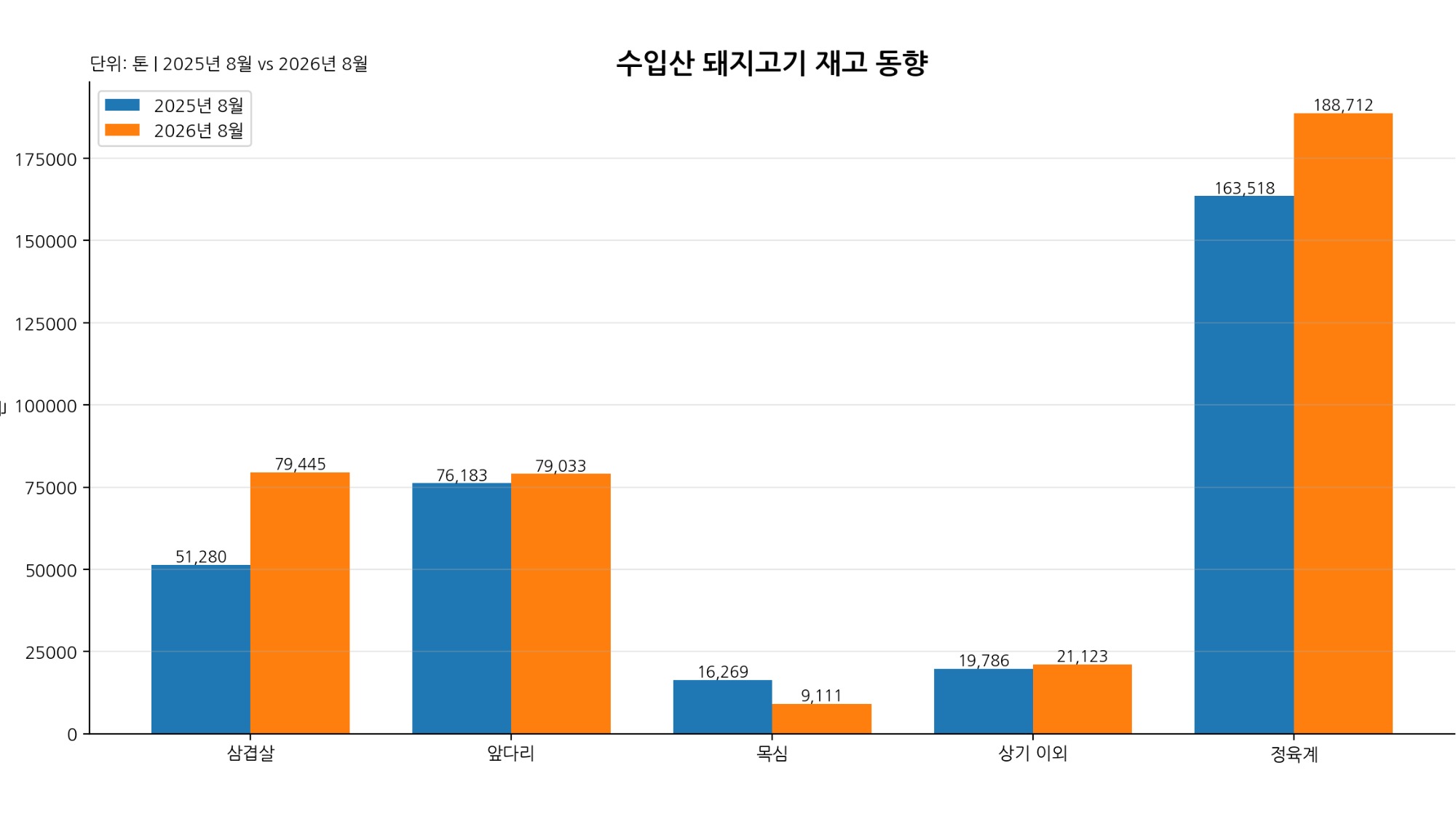
Imports also reached 188,712 tons… Pork belly inventory alone increased by 54.9%
The situation is also challenging for imported meat. In August, the inventory of imported meat increased by 15.4% compared to the same month last year, reaching 188,712 tons. Among them, pork belly led the increase, rising 54.9% from 51,280 tons to 79,445 tons. While pork shoulder increased by 3.7% from 76,183 tons to 79,033 tons, pork neck decreased by 44.0% from 16,269 tons to 9,111 tons.
Differences in inventory composition demonstrate that domestic and imported meats do not behave in the same way. While the inventory of imported pork belly has increased significantly, the backlog of domestic meat is notable, centered on loin, shoulder, and hind cuts. This indicates that different supply and demand conditions are at play for each specific cut.
Pork imports from January to September this year also increased by 13.8% compared to the same period last year, reaching approximately 402,000 tons based on industry meeting data. The increase in import volume and high inventory levels are factors that further intensify sales competition among domestic meat processing and distribution companies.
Sluggish sales but high raw material prices… deepening financial difficulties
The aspect the industry views most seriously isThe weakness in meat sales prices is not being fully reflected in live pig prices.This is the point. Companies that purchase, slaughter, and process pigs must sell pork belly, neck, forelegs, and hindlegs together to secure a profit. As specific cuts remain unsold and accumulate as inventory, they simultaneously bear the costs of purchasing raw pigs, refrigeration and freezing storage, and financial expenses.
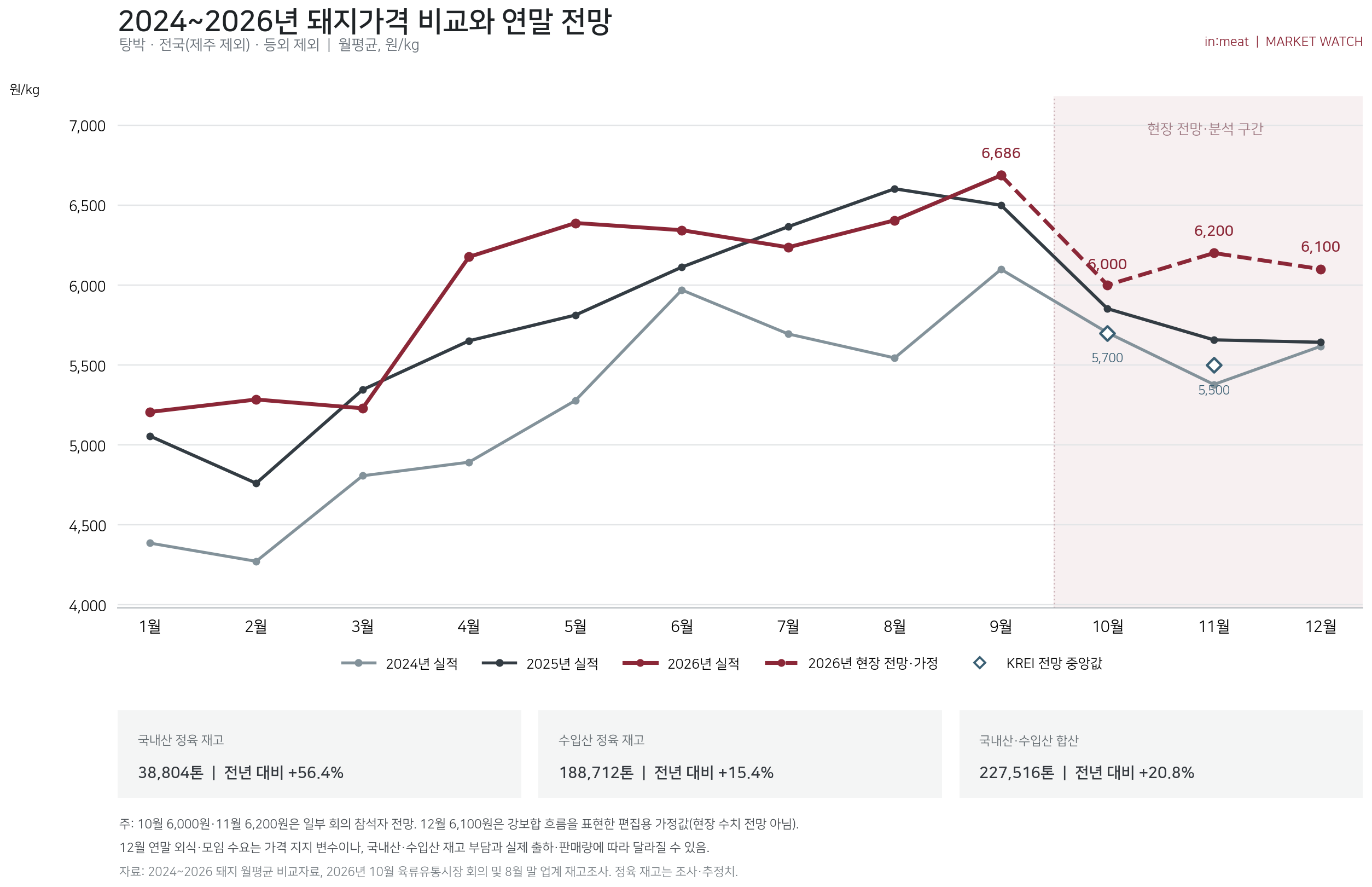
Last September, the average wholesale price of pork was 6,686 won/kg based on the standards presented at an industry meeting. Although prices adjusted in October, meeting participants predicted that the October average would remain around 6,000 won. It is reported that processing companies, finding it difficult to cope with high raw material costs, are adjusting processing volumes or delaying the timing of stocking inventory to reduce losses.
The meat market is struggling, but live pork prices are moving independently.
— Purpose of the field opinions raised at the meat distribution market meeting
One participant explained that freezing and stockpiling pork belly and neck meat is burdensome when live pork prices are around 6,000 won per kg, and that actively switching to freezing would only be considered when prices reach the 5,500 won range. While the break-even point may vary depending on the yield of each company and the selling price of cut meat, there was a clear consensus that stockpiling inventory poses a significant risk at current price levels.
The issue of limited auction volume in wholesale markets was also raised. In September, the total number of pigs slaughtered was approximately 1.526 million, but the number listed in wholesale markets was about 34,000, representing a simple ratio of about 2.2%. Participants pointed out that if the volume of listed pigs that determines auction prices is small, the deterioration of supply and demand in the meat market may not be properly reflected in prices.
However, the low listing ratio alone cannot determine the cause of the high price. Regional shipments, auction demand, and the transaction structure of affiliated companies must also be analyzed. NeverthelessThe gap between the accumulating inventory burden at processing sites and the movement of raw pork pricesIt is emerging as a distinct industrial issue.
KREI forecasts decline in October–November… Some retail sectors expect ‘slightly bullish year-end’
The official outlook places weight on a price decline driven by increased supply. In a report released last September, the Agricultural Observation Center of the Korea Rural Economic Institute projected the number of pigs slaughtered in October to be between 1.62 million and 1.66 million, and in November between 1.63 million and 1.67 million. This represents an increase of approximately 9.0% and 6.2%, respectively, compared to the same months of the previous year. Consequently, wholesale pork prices alsoOctober 5,600~5,800 won/kg, November 5,400~5,600 won/kgIt was predicted that it would go down.
However, some meat distribution industry officials attending the meeting predicted a different trajectory. It was suggested that October would end in the high 5,900 to 6,000 won range, and that prices could rebound to the 6,200 won level in November, driven by promotions at large supermarkets and demand for boiled pork during the kimchi-making season. Other attendees also mentioned the possibility of a slight increase in November, but there were differing views regarding the magnitude of the rise.
December is a variable due to year-end demand and shipments… A ‘slightly bullish’ trend does not signify a recovery
For December, the variable is how much year-end dining out, year-end gatherings, and retail promotional events support pork demand. If consumption of certain grilling cuts recovers after the Kimjang season in November and slaughter volumes are lower than expected, the decline in live pig prices could be limited. During the meeting, opinions were also raised that shipments in November and December may not flood the market all at once.
Accordingly, some field officials believe that rather than a significant drop in prices in November and December following the adjustment in OctoberPossibility of continuing a slight bullish trendThis is being raised. However, this is a forecast based on on-site assessments regarding demand and shipments. If the year-end special is weak, slaughter volumes increase, or discount sales of existing inventory expand, prices may fall contrary to expectations.
More importantly, the fact that pork prices remain stable does not mean the meat processing industry will recover immediately. If live pork prices remain high while inventory is not cleared, processing companies will continue to face a situation where they cannot sufficiently raise the selling prices of their meat despite purchasing expensive raw materials.
Ultimately, the key variable for pork prices at the end of this year is not the price itself, but the structure supporting it and who bears the burden.
While official forecasts predict a decline based on the increase in slaughter volume, some in the distribution sector place weight on the possibility of a stable, bullish trend. Regardless of how this difference actually manifests, it seems inevitable that discussions on supply and demand and distribution structures will be necessary to resolve the management crisis facing the meat processing industry, which is caught between inventory burdens and high raw pork prices.
Sources and materials
① October 2026 Meat Distribution Market Trends Meeting Site and Distribution Materials: Domestic and Imported Meat Inventories, Industry Outlook, and On-site Opinions.
②Livestock Product Quality Evaluation Institute Livestock Distribution Information: For checking pork wholesale price statistics.
③ Korea Rural Economic Institute Agricultural Observation Center, September 2026 Pig Observation: Forecast of slaughter volume and prices for October–November.Check related reports.
※ August inventory is a survey and estimate, and prices for October through December are forecasts, not confirmed values. The simple sum of domestic and imported inventories, which differ in the nature of their raw data, is a reference figure.
- #수입육
- #축산물
- #유통
Related Content

On-site coverage
Hanwoo Association to Hold 'Hanwoo Professionals' Day' Ceremony at National Assembly on October 30… Pledges a New Century for the Industry
The National Hanwoo Association held a ceremony commemorating the first statutory Hanwoo Day at the plaza in front of the National Assembly Communication Center on October 30.
2026.10.31

On-site coverage
‘Sorprise’ Ahead of Hanwoo Day… Up to 63% Off at 1,811 Locations Nationwide
Ahead of ‘Korean Beef Day’ on November 1, discount events for Korean beef are being held at online and offline stores nationwide. The Ministry of Agriculture, Food and Rural Affairs announced on October 27 that it will hold the ‘So-prize Korea Hanwoo Sale’ for 12 days from October 28 to November 8.
2026.10.27

On-site coverage
Making Meatballs and Stacking Burgers... USMEF, "Gifts a Delicious Day to Closer to Dad"
2026.10.25